Family, Wrestling and What to Expect Here in 2026

Family, Wrestling and What to Expect Here in 2026

You would not be reading these words right now if it wasn’t for my dad.

When I was but a wee lad, my mom didn’t want me exposed to such scurrilous things as pro wrestling. This created quite the conundrum for dear old dad, who had been watching since his childhood himself. Apparently, I had a habit of waking up from my nap on Saturday afternoons right in the middle of the main event for World Wide Wrestling. Ric Flair or Greg Valentine or both would be in some mortal peril when my father would hear a meek, “Daddy?” as I stumbled sleepily from the bedroom.

*click*

Keep in mind this was well before streaming and back when even VCRs were not a fixture in every household.

When I was nine, around the time that my grandmother died, I stumbled upon an episode of All American Wrestling. I vaguely remember Hillbilly Jim was involved in the match I was seeing. The details are sketchy nearly 40 years later, but I was quickly hooked… I don’t remember how Dad reacted at the time but he must have been delighted. At long last he had the opportunity to share the wacky wild world of wrestling with me. Since this was 1987, there was a good bit of variety in the available footage in east Tennessee.

The weekends were full of options. WWF had Superstars, Wrestling Challenge, and All American Wrestling. The NWA (which was Jim Crockett Promotions but, to 9- and 10-year-old me, was just “the NWA”) had World Championship Wrestling on TBS at 6:05 every Saturday night. You could catch World Wide Wrestling and Pro on the weekends in syndication. ESPN aired AWA on weekday afternoons (much better than game shows or soaps) and soon added World Class, including past episodes of the latter, which introduced me to the fantastic Von Erichs-Freebirds feud.

Mom tolerated the hobby but mostly didn’t care for it, although in the latter years of her life she became a fan. I always wondered if the only reason that she only got sucked into watching wrestling because, as her mobility declined, it was more difficult to just get up and leave the room whenever Dad turned the channel to something she did not want to watch… and he watched a lot of wrestling. Bianca Belair (a fellow Vol alum like my parents) was a favorite of hers. She was a big fan of Roman Reigns and Damian Priest as well. She literally shed tears when Reigns returned to WWE in the summer of 2024. I guess it was still real to her.

Mom passed away that November, about a week before Thanksgiving. On July 30, Dad joined her. I can’t really express to you the shock that happens, the void that suddenly forms, when you lose both of your parents in a span of about eight months. I recognize that not all families are the same, and not all children are close with their parents, but we were. Normal routines are no longer normal.

In daily and weekly chores, in plans for holidays, and yes, in watching wrestling.

Even as my dad became bed bound, and it was clear that he did not have much longer left, he wanted to watch All In. And so, on a sweltering July afternoon in Tennessee, I made shrimp and scallops sauteed in lemon butter with Red Lobster cheddar biscuits and 10-year-old Bushmills to wash it down. Dad’s awareness ebbed and flowed and he fell asleep long before the show ended, but he enjoyed it.

It’s strange watching wrestling now with the both of them gone. There’s still good stuff out there to be had — past and present.

Going forward into 2026, I’d like to write more here, and said good stuff will be explored in a variety of ways.

Here’s the plan:

Mat Quest is back, baby! My plan to chronicle everything on Peacock before it eventually left the streaming service (which is happening in a matter of days now) got scuttled by my dad’s health issues. I’ve decided to resume my chronological journey through the world of wrestling, first by taking a step back to June of 1973 where I started and catch the good stuff that wasn’t part of the content drop on Peacock.

That means more stuff from Jim Crockett Promotions, the territories, and overseas. You won’t see any Portland stuff included, however, because…
Portland Wrestling gets its own special series! I find this to be one of the most overlooked territories out there in terms of reviews and general coverage, and it’s high time that changes. Might it devolve into a continuing series of articles praising the greatness of Buddy Rose? Entirely possible! Look for the first installment to drop on January 2.

But wait! There’s more!

We also will continue to Review the Kraken as I keep recapping episodes of Kraken Pro Wrestling’s YouTube show … maybe I’ll get caught up to real time by the summer!

And, an occasional What I’m Watching piece, with thoughts on whatever I end up watching that doesn’t fall into one of the above categories.

I’m hopeful for a fun and busy year in 2026. I hope you’ll join me.
Review the Kraken: Episodes 9-11

Review the Kraken: Episodes 9-11

Welcome back to Review The Kraken. This article will review the second TV taping for Kraken Pro Wrestling, which covers Episodes 9-11 of their show on Youtube.

Still about five months behind the current Kraken product and trying to catch up … Kraken places an emphasis on building long-term stories and these three episodes are more about building that narrative than any major developments. I think the episodes also suffered somewhat from some of my favorite Kraken talents being absent: Trever Aeon, Michael Walker, Lamar Diggs, and Trey Shaw all are nowhere to be seen.

Here are some general observations on these three episodes…

Probably the biggest development for the overall story in Kraken is the reveal of a new general manager, Robert Vien. On-screen authority figures are pretty played out but Vien plays things right down the middle (so far), which is as close as you can come to a fresh take on this trope in the 2020s.

These episodes also include the third edition of the Cash In, Cash Out Scramble. This is a fun concept where wrestlers put money into the pot and the winner takes all. One unique addition is revealed here; the match goes to the time limit, the pot rolls over to the next scramble. This scramble involves Will Huckaby, Jak Myles, and two newcomers to Kraken: Edward Draven and CJ Shine. The previous scrambles had six wrestlers, not four, and the match was much more cohesive with the lesser number. They also timed the finish perfectly with the three count right after time expired.

Kevin Kantrell stood out during the Kraken Classic set of episodes. He returns here to face Charlie Kills, who was called Charlie Anarchy during the initial set of tapings. Kantrell is a top-tier talent on the Kraken roster for me and scores an impressive win, making Charlie — who seems an unstoppable monster at times — tap out in the middle of the ring, clean as a sheet.

With some of the aforementioned names absent from this taping, several new faces make their debuts in Kraken. Two of the newcomers jumped out: the H-Town Hittas, a power tag team consisting of two twin brothers. They win an absolutely one-sided squash match and their opponents, Tyreke Robinson and Luke Stone, deserve credit for making the Hittas look so dominant.

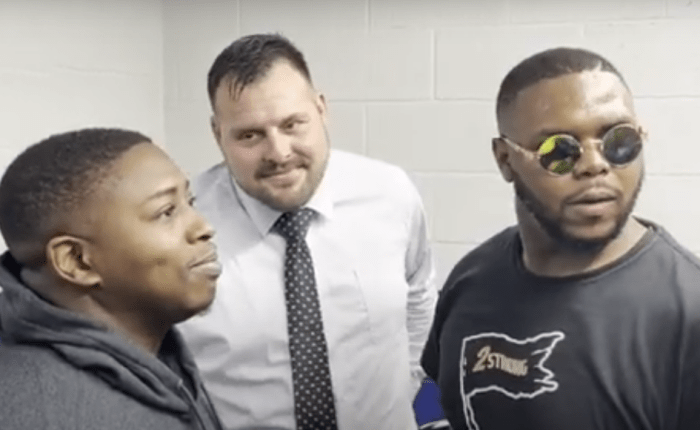
The big highlight from these three episodes is the main event of Episode 11, with Jay 2 Strong facing Brother Azriel for the Kraken Title. Justin Kayse, Jay’s attorney and manager in the The Business stable, technically holds the title and Jay is defending it on his behalf. Azriel steps in after Aeon, the originally scheduled challenger, is mysteriously absent with The Business highly implied as the culprits behind his vanishing act.

Jay has stood out as, arguably, the best wrestler on the Kraken roster at this early stage of the promotion. His Kraken Classic final with Michael Walker remains the best match yet on Kraken TV, but this one comes close to overtaking it. Azriel has a unique look and a fine power game, also displaying much more agility than you would expect from just looking at him. Jay makes Azriel look especially strong in defeat and the home stretch is very good with a bait-and-switch finish that hearkens back to the heyday of territorial wrestling. If the goal is to inspire the fan base to want to see Kayse dethroned as champion, mission accomplished.

You can check out all three episodes here:

Mat Quest: The Master Index

Mat Quest: The Master Index

A chronological viewing guide to the archive of wrestling content currently uploaded to Peacock:

Introduction (How the project will work and why it is being done)

1973 — A prologue installment

Madison Square Garden (3/17/75 & 4/14/75)

All Star Wrestling (9/13/75, 1/10/76, & 1/17/76)

February, 1976 (MSG, 2/2 & All Star Wrestling, 2/28)

Spring, 1976 (All Star Wrestling 3/6 & 3/20; Andre the Giant vs. Ernie Ladd from MSG on 4/26)

Wrapping Up 1976 (MSG, 8/7/76 & 10/25/76; Bobo Brazil vs. Bruiser Brody from MSG on 11/22)

Review the Kraken: The Kraken Classic

Review the Kraken: The Kraken Classic

Pro wrestling is more accessible than ever. Between streaming services, in-house online broadcasts, and good old-fashioned TV deals (a few still exist), fans have more ways to watch more wrestling from around the world than at any point. 

Imagine telling the you from two decades ago – even the you from 10 years ago – “some day there will be so much wrestling available to watch that you will never be able to keep up with it all.” And yet, today, WWE puts out six hours of content per week – and that doesn’t count the feeder shows like Main Event and Level Up. AEW cranks out five hours of TV wrestling each week — and that does not include the weekly Ring of Honor episodes. If there is a pay-per-view / premium live event that week, tack on another three hours. Full shows are available from a host of international promotions, especially in Japan, but those are usually three hours or more, requiring a real investment of time if you intend to watch the whole thing. 

And so, the approach that Kraken Pro Wrestling has chosen feels fresh in its convenience. This neophyte promotion located in southern Georgia breaks down its live events into snack-sized installments of TV for its YouTube channel. Each episode lasts 30 minutes, at most. A couple of episodes clock in closer to the 10-minute mark. 

But, with so many wrestling promotions out there, is Kraken worth watching? I think it is. And hence, welcome to my efforts to Review The Kraken! We kick off this endeavor by looking at the first eight episodes of TV, where the first Kraken champion was crowned in an eight-man tournament called the Kraken Classic. 

These shows happened back over the summer and so given that fact, I won’t attempt to bore you with a match-by-match or segment-by-segment breakdown. Instead, I wanted to take a look at some of the standout wrestlers on these early Kraken shows. They all have one commonality – each left me wanting to see more of them, whether it be here or elsewhere.

Big Business – This three-man faction comprises the top heel act in Kraken. The manager, Justin Kayse, actually came out of the tournament holding the title, as Jay 2 Strong won the Kraken Classic only to see Kayse declare himself as the champion. Jay was incredibly solid in his three tournament matches and the final against Michael Walker is the best match of the tournament. Lamar Diggs is the enforcer of the group and has the physical presence and requisite menace to fill that role. You could plug him right into the middle of the Mid-South territory in its heyday and he would fit right in with those sluggers. I like the concept of a heel manager holding the title everyone is chasing but, through these first eight episodes, I found Kayse somewhat lacking both as a talker and during interference spots sometimes self-sabotaged by poor timing. We will see how Kayse rises to the occasion in future installments.

Michael Walker – Probably the purest babyface on the roster through these first eight episodes. He acquitted himself well in all three tournament matches, all against opponents of different styles, including both wrestlers in Big Business. His match with Diggs was a fine example of one of my favorite tropes, pitting a smaller, speedy wrestler against a powerhouse. Even with the loss in the finals, Walker emerged from the Classic portrayed as a fine never-say-die underdog who you wanted to root for.

Trever AeonI have seen Aeon in person a couple of times and followed his work online in recent years. He is one of the more underrated wrestlers on the Southeast scene to me and stands out through his look, his versatility, and the explosion he demonstrates in some of his offense. 

Trey ShawI knew nothing about Shaw before his first-round match in the Classic (found in episode 4 of Kraken), but immediately was impressed. Again, these are short episodes, but in the span of about 15 minutes, he stood out with his combination of look, size, promo ability, and snug offense. 

All Star Special Will Huckaby and Hold My Beer Hanson are one of the more popular teams in Georgia and probably the merch champions of the independent scene in that state. Hanson is also the promoter of Kraken, something that is readily acknowledged on commentary. While this is hard to deny when Hanson is doing local TV spots to promote Kraken using his real name, I emerged from these eight episodes unsure if this was a little too much “behind the curtain” for me. A tip of the cap to Hanson and Huckaby (who is the booker) and not following in the footsteps of so many of their predecessors and making themselves the focal point of the shows.

Kevin KantrellKantrell is not part of the Kraken Classic but he stands out with a rugged, intense style. In his one match in the first eight episodes, he carries a green opponent to a solid effort and then, after the result does not go his way, beats down the referee like the official handed him a light envelope at the end of the night. I came away wanting to see more of him, for sure.

Kody MaddenHaving done wrestling commentary in the past, I know how difficult the job is. Kody is the lead broadcaster for Kraken and does a good job with the juggling act of calling the action, telling a greater story, and directing traffic in a three-man booth – although the other two members of that booth are both heels and have similar-sounding voices.

One of the most common, widespread — and often deserved — criticisms of professional wrestling as we sit almost halfway through the 2020s is the sameness of it all. Matches up and down the card, regardless of whether the promotion is located on the globe, see everyone working a similar style. Hanson and Huckaby have done a solid job assembling a roster of different characters with different styles. I will keep watching through their archive of episodes and came away from these first eight shows wanting to see what happens next, and really, isn’t that the first goal for any wrestling promotion?

Imperial Pro April 22 Preview

Imperial Pro April 22 Preview

Every spring, approximately 1.5 million Peeps get eaten.

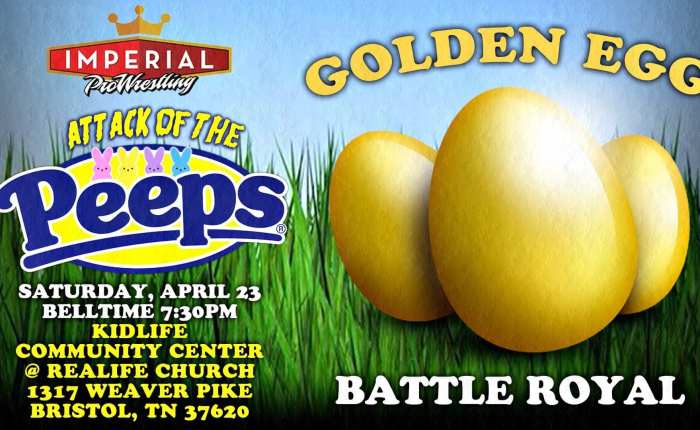
Tomorrow night, in Bristol, it’s payback time. At least, that’s the inspiration for the show name for the next Imperial Pro Wrestling event, “Attack of the Peeps”. It happens Saturday, April 23, as Imperial Pro returns to its “home” venue, the community center of Realife Church, located at 1317 Weaver Pike in Bristol, TN.

Front row tickets are sold out, but general admission tickets remain available for $12 apiece. Kids 12 and under get in free.

Here is the current announced lineup:

Axton Ray defends the Imperial Championship against Hunter Drake. Axton is a local favorite who just returned from his first tour of the United Kingdom.

Kenzie Paige Henry defends the Imperial Women’s Title against Alice Crowley. Kenzie recently announced she had signed a contract with the National Wrestling Alliance.

Greg Rocker defends the Hickory Tree Hardcore Title against CJ Knight, Big Al and Toby Farley.

Jason Kincaid vs. AJ Cazana

Judi-Rae Hendrix vs. Michelle Green

The Golden Egg Battle Royal

Follow Imperial Pro on your social media platform of choice: Facebook, Twitter and Instagram.

365 Wrestling, Day 7: Ric Flair vs. Bobby Eaton (WCW Main Event, 1/7/90)

365 Wrestling, Day 7: Ric Flair vs. Bobby Eaton (WCW Main Event, 1/7/90)

365 match reviews, one for each date on the yearly calendar? Challenge accepted. Welcome to 365 Wrestling.

You may have heard or read a story about “Beautiful” Bobby Eaton being one of the nicest people in wrestling?

Whatever you’ve seen or heard, it’s probably true.

In the 2000s, Bobby lived in my hometown for a little while. I got to meet him through a mutual friend. He had a wrestling school downtown for a little while, and a friend and I helped move the ring and apparatus into the upstairs location. He even came to the house a few times for cookouts and pay-per-view nights. Years later, after Eaton had moved on and I was working as a commentator for an independent promotion in the area, Eaton had been booked as a manager. Not only did he remember me, but when I said something about being tired (I was loading trucks at FedEx in the wee hours of the morning at the time, as my writing work had slowed down), he offered me a coffee.

His coffee.

For all who knew him, I assure you, he is missed.

Though Eaton is known moreso for his tag work, especially in the Midnight Express, in today’s installment of 365 Wrestling, we’re taking a look at a slice of his singles action, as he challenges Ric Flair for the NWA Worlds Heavyweight Title from a 1990 Episode of WCW Main Event.

You can find this match on YouTube.

The Match

This is the second title shot for Eaton in about a month. In the first, Flair won by DQ after Eaton’s ever-present manager Jim Cornette interfered to keep Beautiful Bobby from getting ensnared in the figure-four leglock. Flair was in the midst of a rare run as babyface champion, roughl;y two months removed from settling the score in a feud with Terry Funk that remains one of my favorites of all time. (Note: if you haven’t seen them, go and watch his matches with Funk from the 1989 Great American Bash [arguably one of the best pay-per-views of all time] and Clash of the Champions IX, both available on Peacock.)

Flair spent so much of his career, especially during his runs as champion, making his opponents look strong and gives plenty to Eaton, but Beautiful Bobby also embraces the role of making his foe look like a million bucks. Eaton makes Flair’s chops look devastating, most notably one where he’s standing on the apron and drops facefirst to the floor.

Momentum shifts on a, pardon the pun, beautiful swinging neckbreaker from Eaton and Lance Russell brings up Funk’s piledriving Flair through the table the previous May and ponders its cumulative effects. By the way, Russell puts in some stellar work on commentary. He’s calling the match by himself (which I can tell you, from experience, is a challenge) and simultaneously builds the story of the match, reacts organically to major events as they happen, and gives a straight call of the action without delving too far down any one path. Definitely worth studying for any current or aspiring commentators who read this.

Eaton focuses his attack on the neck of Flair, sprinkling in several of his perpetually excellent-looking punches and using a version of Flair’s signature figure-four against him, but securing the hold around the neck of the champ. Cornette plays his role to the hilt, interfering at a couple of opportune moments to whip the crowd into a frenzy and add extra sizzle to the match like a good manager should. After Flair makes an impressive and creative counter to a top rope kneedrop by Eaton, Cornette’s tactics bring down his man, as Flair grabs the loaded tennis racquet and wallops both manager and challenger before scoring the decisive pin.

Final Rating: 7.2

This is a very good TV main event with significant stakes and sees two of the best from their era facing off in a rare one-on-one encounter. My only real criticism is that Eaton doesn’t seem a legitimate chance to win, given the midcard status of the Midnight Express at the time of this match.

What’s Next

Two of Japan’s all-time greats square off in their only singles battle.

Here’s the complete, ongoing list of matches in this project.

Follow In Moorehouse Wrestling on FacebookTwitter and Instagram!

365 Wrestling, Day 6: Awesome Kong vs. Gail Kim, No DQ (TNA Final Resolution 2008, 1/6/08)

365 Wrestling, Day 6: Awesome Kong vs. Gail Kim, No DQ (TNA Final Resolution 2008, 1/6/08)

365 match reviews, one for each date on the yearly calendar? Challenge accepted. Welcome to 365 Wrestling.

American women’s wrestling has come a long way from meaningless filler bouts and bra-and-panty matches. The Knockouts division in TNA Wrestling helped create that change. The Knockouts are still going strong in what is now known as IMPACT but really turned a corner with the Gail KimAwesome Kong rivalry. Let’s take a look at a chapter of that feud, a No DQ Match from Final Resolution 2008.

You can watch this match on YouTube, and I also have embedded it below:

The Match

Kim became the first Knockouts Champion in the fall of 2007, and her major foe during that reign was Kong, who made a name for herself in Japan and on the U.S. independent circuit before coming to TNA. You also might recognize Kong from her role on the GLOW Netflix show.

Certain stories just work in wrestling, to the point they’ve been told countless times. This is one of them, with the gutsy undersized fan favorite (Kim) going against the unstoppable juggernaut villain (Kong). Kong is in her element in this match, battering Kim, tossing her around, manhandling referees and menacing Mike Tenay and Don West at the commentary table. Meanwhile, Kim makes Kong look like a monster. Kim takes a spinning backfist while seated on the top turnbuckle, taking a spill that looks even nastier when one leg gets hooked, leaving her dangling above the floor.

They reap plenty of fruit from the No DQ stipulation. A brawl through the crowd whips the Impact Zone fans into a frenzy and sees the first major momentum shift in the champ’s favor, when Kong misses on a charging attack and Kim zeroes in attacking Kong’s lefty arm and shoulder. Kim makes her comeback by annihilating Kong with multiple chairshots, followed by a top rope splash and has a great reaction when it doesn’t get the pin. Kong’s aggression toward the referee(s) proves to be her undoing, and prey for a schoolboy pin by the champion.

After all this, these two wrestled yet again on the subsequent episode of TV, where Kong won the title after interference from her new manager. Why not do that here, especially since Tenay explicitly mentions “an associate” of Kong’s being in attendance for the pay-per-view? Beats me. This type of nonsense booking was common in TNA.

Final Rating: 5.9

This rivalry between Kong and Kim helped establish the new Knockouts division, and this is the best match from their feud that I have seen. It’s a solid, satisfying match to watch.

Here’s the complete, ongoing list of matches in this project.

What’s Next

We remember an all-time great wrestler, and person.

Got a match you’d like me to watch as part of this 365 Wrestling project? Agree or disagree with my take on this match? Let me know by using the contact form on this site, or reach me on Twitter.

365 Wrestling, Day 5: 8 Man Tag (Pacific Northwest Wrestling, 1/5/80)

365 Wrestling, Day 5: 8 Man Tag (Pacific Northwest Wrestling, 1/5/80)

365 match reviews, one for each date on the yearly calendar? Challenge accepted. Welcome to 365 Wrestling.

Do you enjoy watching good wrestling? Are you a wrestler looking to improve? If you can answer yes to either question, then I have one piece of advice: watch more Buddy Rose.

Today, we’re taking a look at a two out of three falls tag match from Portland in January 5, 1980 featuring Rose — Pacific Northwest Wrestling’s top heel at the time — teaming with the Kiwi Sheepherders, Butch Miller and Luke Williams (you may know them better as the Bushwhackers), and Sam Oliver Bass (better known as Outlaw Ron Bass). Their opponents are the quartet of Roddy Piper, Rick Martel, Dutch Savage, and Stan Stasiak. You can find this match on YouTube, or embedded below:

Part 1
Part 2

The Match

Portland weekly TV at the time was structured around long matches, many of them two out of three falls with sponsor plugs and interviews between falls. This match follows that formula. It’s also the latest chapter in a feud between Rose and Piper that began the prior spring. Rose has recruited Bass and the Sheepherders to his “Army.” The shenanigans between Rose and Piper in 1979 included Rose, in an act of sublime dastardly heeldom, setting fire to Piper’s kilt from the Crow’s Nest broadcasters’ position while the Rowdy Scot was part of a tag match. Fun fact, PNW pre-taped its TV show at the time, but fans watching thought it was happening live and called the fire department.

Piper’s team consists of Martel, who is new on the scene in Portland; Savage, a mainstay in PNW and one of the promoters of the territory; and Stasiak, best known for his “heart punch” and being the man who dropped the WWF Title to Bruno Sammartino to begin Bruno’s second reign as champion. By this point, Stasiak is in the twilight of his career.

The booking here accomplishes three goals, which is an impressive juggling act. First, building Martel for an imminent shot at Harley Race and the NWA Worlds Heavyweight Title. Second, to advance the feud between Piper and Rose. Third, to establish Rose’s Army as a force.

Most of the action is basic pro wrestling you’ve seen a thousand times, but it’s all done well and the crowd is red-hot for the first fall, which lasts more than 20 minutes. Rose is involved on the three big highlights of the match: a rapidly-paced exchange with Piper in the opening minutes, taking a Martel Irish whip into the opposite corner where he throws himself headlong above the turnbuckles to smash into a long pole extending from the ringpost, and then, in the second fall, feeding into a late hot tag by Martel, who busts out a huracanrana (in 1980!!!) as part of his comeback.

Rose sells for everybody in this one, whether it be an exaggerated bump on the apron after Savage punches him, or reacting to Stasiak’s “reverse pumphandle armbar”, as Frank Bonnema calls it, like he’s being interrogated in a medieval torture device. This match loses quite a bit of steam heading into the second fall and the intensity continues to diminish — the opposite of what you want — with the minute-by-minute calls of ring announcer Don Owen (the promoter of the territory), making a time-limit draw finish as obvious as a flashing neon sign.

Final Rating: 6.0

This one is definitely worth seeking out to watch. You get a good look at a highly-energized Piper, the Sheepherders with a distinctly different look, and Bass in his prime. The star, though, is Rose. Rose shines in the style of the Portland territory, thanks to his combination of tremendous promos, meticulous mannerisms in the ring, and bumping heedlessly to make his opponents look like a million bucks. I assure you, this won’t be the only time you see Rose on this list.

What’s Next

Two of the top female wrestlers of the 2000s battle in a No DQ brouhaha.

Here’s the complete, ongoing list of matches in this project.

Follow In Moorehouse Wrestling on FacebookTwitter and Instagram!

365 Wrestling, Day 4: Shinsuke Nakamura vs. Kota Ibushi (NJPW Wrestle Kingdom 9, 1/4/15)

365 Wrestling, Day 4: Shinsuke Nakamura vs. Kota Ibushi (NJPW Wrestle Kingdom 9, 1/4/15)

365 match reviews, one for each date on the yearly calendar? Challenge accepted. Welcome to 365 Wrestling.

When I think of January 4, I think of wrestling at the Tokyo Dome. After all, New Japan Pro Wrestling has held an event every January 4 since 1992–a tradition dating back 30 years and counting. I’ve followed NJPW regularly since Wrestle Kingdom 10 in 2016, so to find a noteworthy Wrestle Kingdom match I hadn’t seen I went back to 2015 for this contest between Shinsuke Nakamura and Kota Ibushi fromWrestle Kingdom 9.

New Japan World offers this match with original and English-language commentary; Kevin Kelly provides the latter in a recorded version after the fact. I opted to watch the original version, because the version with Kelly slightly dampened the volume of the live crowd. You might be able to find alternate broadcasts online as well.

The Match

Nakamura is in his fourth reign with the Intercontinental Title, which he’s credited with elevating from a midcard title to a more prominent, coveted championship. This also eventually sets the stage for New Japan unifying the IWGP Intercontinental and Heavyweight Titles.

Wrestle Kingdom has had some wild entrances through the years and here, Nakamura heads out in an amazing oversized gold crown and red cloak befitting his “King of Strong Style” moniker.

If you like wrestling matches where the intensity builds throughout, this is the one for you. From his entrance through the post-match you witness the massive charisma of Nakamura. He’s oozing overconfidence as the match begins, trying for his finishing knee strike (called the Kinshasa in WWE but known as Bomaye in New Japan) mere moments into the match.

If you’ve only seen Nakamura’s WWE work, including his matches in NXT, don’t miss this match. Nakamura’s presence is captivating here, whether he is on offense delivering some brutal-looking knees and strikes (more on those later), selling or playing to the crowd. At one point about eight minutes in, Ibushi tries to make a comeback but Nakamura arrogantly and literally brushes off his forearm strikes.

We’re several years removed here from the Ibushi who won consecutive G1 Climaxes and captured both the major IWGP titles at Wrestle Kingdom in 2020. You see the potential, though. Ibushi is the brash young upstart here; after all, he made his challenge for this match by attacking Nakamura from behind with a German suplex. In this match, he starts mocking Nakamura’s mannerisms, including his quivering “Good Vibrations” foot choke in the corner. He does some of the flying you come to expect from Ibushi at this stage, including a spectacular moonsault where he leaps from the mat to the top rope in a single bound, then vaults onto Nakamura at ringside.

Once these two shift to throwing strikes, that intensity I mentioned reaches a new level. A head kick by Ibushi drops Nakamura in a heap. After Ibushi misses a Phoenix Splash, Nakamura hits a Bomaye on the third attempt — this time to the back of the head — and then starts stomping the life out of Ibushi as he crawls for the apron. Ibushi responds with some straight punches (a real rarity in modern NJPW) and soon these two are teeing off on one another with strikes that blur the line between a predetermined pro wrestling match and a legitimate fight in all the best ways. Wrestlers watching and reading this should take note of how Nakamura makes the most of a single punch, delivered out of “Red Shoes” Umino’s viewpoint after he shoves the referee into Ibushi.

In the midst of the back-and-forth slugfest, Ibushi continues his mockery, mimicking Nakamura’s mannerisms and delivering his own Bomaye, which Nakamura kicks out of at one! This sparks a spectacular finishing stretch that is so compelling I won’t even chronicle it so you can watch it, and savor it, on your own.

Final Rating: 9.6

This is an incredible match. It tops all of the Wrestle Kingdom main events I’ve seen from Ibushi in recent years, and it’s immediately my favorite Nakamura match ever. One criticism I have about New Japan is match length. It’s expected now that an NJPW main event is going to go about 30 minutes or more, whether it’s a major event or a “Road To” show. This match has all of the athleticism and drama you see in current New Japan epics, but with none of the filler to pad the length. A beautiful example of pro wrestling as sport blended with art that you should not miss.

What’s Next

We hop in the Wayback Machine to the Pacific Northwest in 1980 for some eight-man tag action.

Follow In Moorehouse Wrestling on FacebookTwitter and Instagram!

365 Wrestling, Day 3: Juventud Guerrera vs. Mortis (WCWSN, 1/3/98)

365 Wrestling, Day 3: Juventud Guerrera vs. Mortis (WCWSN, 1/3/98)

365 match reviews, one for each date on the yearly calendar? Challenge accepted. Welcome to 365 Wrestling.

Back when the Monday Night Wars were in full swing, WCW became extremely aggressive signing wrestlers. This created a glut of talent — more than could be used at any one time — to the point that wrestlers were under contract for years and rarely booked or not used at all. Anyway, this also led to some bizarre and highly entertaining matchups on WCW’s three C-level shows: WCW Saturday Night, Pro, and WorldWide. We reach into that wacky grab bag for today’s match: Juventud Guerrera vs. Mortis from the Jan. 3, 1998, episode of Saturday Night.

You can find this match online with a shrewd bit of searching.

The Match

A quick plug of the WCW Hotline by Mean Gene Okerlund has us fully ensconced in WCW nostalgia mode. Tony Schiavone spends a little time on commentary building a story that Mortis is out to become the best masked wrestler in WCW. This is one of those C-show plots that basically occurred in a vacuum. Case in point: Juventud wins the Cruiserweight Title for the first time less than a week later on Thunder, while by February of 1998, Mortis has abandoned the character altogether, unmasking and allying with Raven.

More people are aware of the ability of Mortis (aka Chris Kanyon), and his influence on future wrestlers, after his Dark Side of the Ring episode. We see some of that innovation here. Following a very well-timed bit of interference by James Vandenberg (better known as the Sinister Minister these days), Mortis takes control and busts out this:

After consulting with WCW super-enthusiast and technical wrestling specialist Jeff Connelly, we’re going to call this a deadlift pumphandle fallaway slam. It’s not so much the trip as the landing — Juvi gets dropped throatfirst across the top rope then crashes back to the canvas.

Mortis has a big size advantage and it plays into a teased comeback by Juventud, who converts an apparent tilt-a-whirl headscissors into a sleeper (Dusty Rhodes delightfully calls this as a “whirlybird”). Later, Juvi uses Mortis’ larger size against him, countering an original Flatliner (from a fireman’s carry off the second rope) with a sunset flip powerbomb. However, it’s not long before Mortis finishes with a move Schiavone calls “the D.O.A.” but is now the move we wrestling aficionados know as the Flatliner.

Final Rating: 5

There’s nothing wrong with the action here, but not a lot worth seeking it out, either. However, current and aspiring managers should watch the interference by Vandenberg for the artful timing on opening the ropes quickly and at the exact ideal moment.

What’s Next

It’s January 4, so there’s only one destination… The Tokyo Dome.

Here’s the complete, ongoing list of matches in this project.

Follow In Moorehouse Wrestling on Facebook, Twitter and Instagram!