Review the Kraken: Setting up the Season

Review the Kraken: Setting up the Season

For a small independent wrestling company that runs all its events in the same town in South Georgia, Kraken Pro Wrestling does some ambitious long-term storytelling. Frankly, it’s a shame this promotion doesn’t have more of a following than it does, especially at a time where building a narrative over time is becoming somewhat of a lost art, especially at the independent level.

We pick up here in June of 2025. Kraken just closed out its first “season” at the Kraken Classic, also the one-year anniversary show. Trever Aeon unseated Justin Kayse to become Kraken Pro Champion. The fact it’s a new season gets mentioned several times during this set of episodes and, like a good season premiere should, there’s a good bet of set-up for the twists and turns to come.

Here’s all the episodes included in this review:

Episode 53

Women’s action kicks things off as Jaz Jones takes on Alexandra Quinn. First thing that jumps out is the crowd size; it’s another big house, coming off the Kraken Classic, where it also was packed. The latter is making her Kraken debut and she’s an AR Fox trainee. Quinn is green but there’s something there; that ripcord spine buster of hers looks especially good. This match gets a little wonky down the stretch — again, green — but Jasmine wins clean. More heels should.

The major plot point from this episode is Donnie Harris, the lead broadcaster, stepping down as general manager. He’s replaced by Alex Chase, who used to be involved with something called Georgia Independent Professional Wrestling, which is an incredibly generic name and I say that as someone who used to help out with the Pro Wrestling Federation in East Tenessee. Of course, Justin Kayse and The Business have to come out and immediately confront the new guy in charge, just as they have done with the two previous GMs in Kraken. Kayse is sporting a neck brace after taking his first major bumps, and lumps, at Trever Aeon’s hands at the Kraken Classic (see the photographic evidence below).

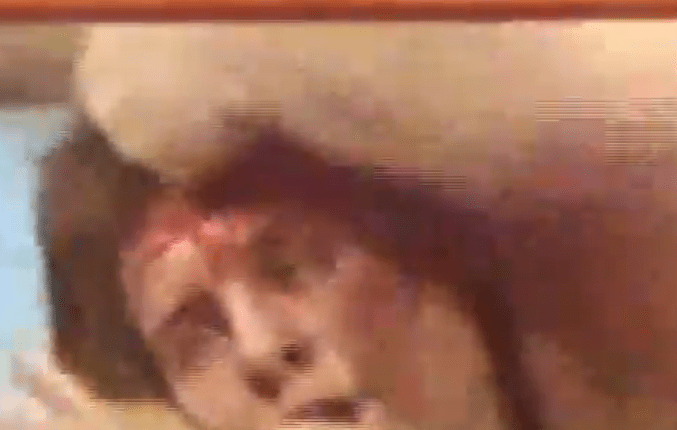
Justin Kayse lies unconscious on the mat at the Kraken Classic,
Just running back this picture to make Justin Kayse mad … but look how peaceful he was sleeping at the Kraken Classic!

Kayse gets great heat here; he is a much better talker than he was when Kraken first began. Chase also is comfortable on the mic. But if you’ve been watching American televised wrestling at all in the past 30 years, you’ve seen this story before. Seriously, this has been a plot device for three decades now. Surely we can figure out something new.

Kayse is getting ready to position Dominic Stuckey to challenge Aeon for the title when Jay 2 Strong grabs the microphone and puts himself in the match. Apparently Kayse’s legal acumen is no match for the overarching social doctrine of dibs. With that apparently settled, The Business starts to leave, but wait! Stuckey has a match Right Now against…

Brother Azriel. These are two of my favorites on the roster and the match is as good as I expected. Azriel brings a rugged hoss energy that is really unique in this promotion. Stuckey, meanwhile, stands out not just with his technical ability or the moves he does; it’s those beats in between, like when he trash talks his opponent or the fans or says something to Kayse. After Dom and Kayse get crossed up and the attorney takes a spill, Azriel plants Stuckey with the Woodgrain which finishes the match — and should in every match where he hits it barring some serious shenanigans. This felt like a big win for Azriel to propel him to a greater role in Kraken. Works for me!

Episode 54

Kay Casiano, who serves as ring announcer and backstage interviewer, stays pretty busy on this set of episodes and that’s a good thing. She is very smooth and polished in the hosting type role. She gets some words with the new GM Chase, and Noir interrupts. They have history in Georgia Independe… let’s just call it GIPW.

It’s scramble time! Jak Myles puts the freshly minted Cash In Hand Title on the line, and $225 also is at stake! That’s almost half of a PS5 at current prices! The Cash In Hand Title is a fusion of CHIKARA’s Campeonato de Los Parejas contender rules and Money In The Bank. Defend three times, and the champion gets a title match with the Kraken Pro Champion he or she can “cash in” at any time. Like on screen authority figures, this cash-in gimmick has been around wrestling a long time, so I hope the Kraken brain trust has some unique twist cooked up for it.

Joey Hyder, Nathaniel Vamderbilt, and Dante Dripp are the opponents in the scramble. Vanderbilt leans into the dark side of the force, mocking Sweeper with the broom. Let’s see more of that; nobody wants to root for the spoiled rich kid. Dripp has a very punchable face, which makes him an ideal wrestler to put over others. Hyder wins the match, which I didn’t expect after Myles’ win in the big scramble at the Kraken Classic, which felt like a big deal.

Will Huckaby, who’s still the perpetual grump of Kraken, is the guest on the Diamond Den and shuts down the segment without answering a question. He’s probably tired of Duke complaining about referees’ counts being too fast or slow, or me complaining to him about Duke’s complaining, or a combination of the two.

All Star Special face Quick Drip in the episode headliner. The latter team is made up of Nick Quick and Travis Ray, who apparently join Dante Dripp to make this a three-man faction. They don’t explain this until the next taping, but I felt compelled to do so here for some reason. I like Travis a lot; he hits hard and has an explosive energy, but I think that gets lost with some of the silliness he does. The match is window dressing for a pretty strong angle involving Noir, who jump All Star Special. Huck gets put through a door that gets propped up in one corner. Why is a door under a wrestling ring, anyway? Duke points this out and for once I agree with him. The heels tie up Sam Hanson in the ropes and Mrs. Wright hits the ring with scissors and electric clippers. The crowd reacts right away before a single lock of Hanson’s hair is cut, and they give him a quick and dirty reverse mohawk. Donnie squalling, “she’s not a licensed cosmetologist!” was a line that was so ridiculous and also delivered with such conviction that I horse laughed in an empty room. This was the best thing Noir has done in Kraken, by a wide margin.

Episode 55

My favorite of these four episodes, and the entire story here centers on elevating talent in defeat.

It starts in the tag match, with Don Haylo and Jayy Wells teaming for the first time and taking on the H-Town Hittas. I’ve been a Don Haylo guy really since he first started showing up in Kraken, and I’ve always been a sucker for a “strong guy / fast guy” tag team dynamic. Jayy has leveled up gear-wise with the custom basketball jersey. I’ve written before about how the ascent of Wells in Kraken reminds me of the growth and development of young lions in New Japan Pro Wrestling and that progression continues here. Wells is delivering strikes to the Hittas with a delightful mix of intent and impact. The Hittas give much more here than they usually do but eventually assert themselves and win. Still, the team of Haylo and Wells was established here in defeat.

Kevin Kantrell faces ERC in the main event and Kantrell elevates his opponent here. ERC stands out in Kraken thanks to a sneaky opportunist style. He doesn’t try to look cool or do flashy moves; he takes shortcuts and the openings available to him. At one point, ERC suckers Kantrell with a straight punch, and Kantrell’s reeling sell into the ropes makes it seem like he got zapped with a stun gun. ERC kicks out of the Styles Clash (which the commentators weirdly dance around but never fully identify) before Kantrell finishes him with the crossface.

Come for the matches; stay for a rather entertaining segment filmed outside the building where Noir celebrate with Hanson’s newly shorn hair.

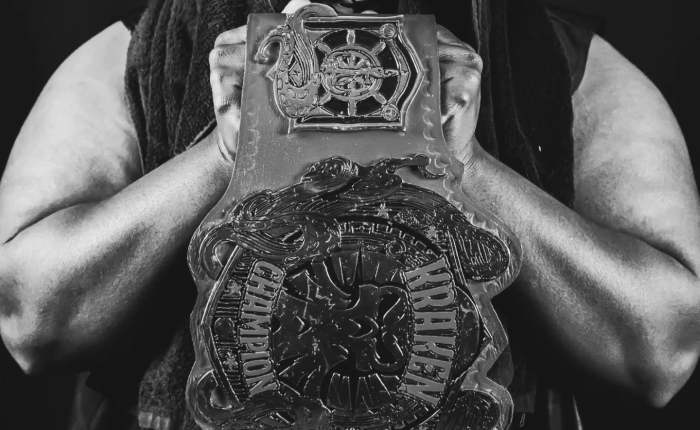
The Diamond Den on this episode with Alex Chase is a total mess. Alex spends half the time talking covering his mouth as he plays with his beard, and I say that as a habitual whisker fiddler. Alex is here to explain the Tides of War, the ongoing round robin tournament that is going to eventually crown the first Kraken tag champs (belts pictured above) and play out over the next eight months (!), which also seems an insane length for an independent promotion. Problem is, his verbal spiel contradicts the graphic that plays during the segment. No one comes away from this looking prepared or knowledgeable. Swing and a miss here but at least the new belts look snazzy.

Episode 56

This episode opens with a Strap Match between Rose Gold and Tsu Nami, which was scheduled for the Kraken Classic but had to get moved. The strap snaps in the first few seconds of the match and they have to improve everything that ensues. This is not a good match but I give them credit for trying to make it work on the fly. Rose wins by making Tsu Nami pass out to a choke just before the time limit expires. Duke thinks their issue is not settled. Of all the dastardly things he has said as the heel broadcaster, this is the most unforgivable yet.

After Donnie summons his best Don West to hawk some Kraken merch, we proceed directly without passing Go to the main event.

As for the main event, which headlines both this episode and the taping … There’s a lovely beat in the introductions when Kayse starts trying to go at Kay Casiano for referring to him as the “former” champion. It’s lost somewhat by bad audio that makes it sound as if Kay is announcing the participants while stuck at the bottom of a well. Donnie referring to “the Harris administration” made me laugh.

Trever and Jay have had multiple matches in Kraken by this point — some singles and some in tags. This is probably their best. I didn’t care for the commentators trying to say Jay has owned Trever in past matches, when Aeon beat Jay clean in their last meeting and in fact that’s how he earned the match with Stuckey at the Kraken Classic. Jay has established himself as one of the best wrestlers in Kraken. He’s so good at the little things. Case in point, he uses the tiniest bit of heel sleight of hand to take control, which leads to Kayse trying to slide his briefcase in the match and Referee Clark ejecting Kayse from ringside.

This is the first title defense for Trever and the first legitimate title match in Kraken history, and both wrestlers raise the stakes appropriately. Jay counters the Kiss Kiss Bang Bang with a modified ushigaroshi. Later there’s a gnarly vertical suplex into the corner. Jay shows a ton of fight now that he’s on his own, which of course is the entire point of what’s building. Eventually, Clark gets bumped in the midst of an F5 that is lamely referred to as a a “finishing maneuver” on commentary. Jaz Jones shows up with Kayse’s briefcase and delivers one of the most gentle foreign object shots ever. I suppose she’s joined The Business now. Trever ultimately hits Kiss Kiss Bang Bang and wins it clean in center ring to a big reaction from the crowd.

I didn’t care for the shoehorning of Alex Chase into this match. He holds up the belt during introductions. He presents it to and straps it around Trever after the final bell. That’s all referee duty. We get it; he’s the new authority figure.

Want to catch up? Check out the full index of “Review the Kraken” content.

From the Crow’s Nest: 1978

From the Crow’s Nest: 1978

Our journey through the Portland Wrestling territory turns the calendar from 1977 to 1978.

Unfortunately, footage from this year is pretty sparse. We’ve got two partial episodes from the first quarter of the year, one interview with Buddy Rose and Ed Wiskowski, and … that’s it. Luckily, all of that footage is available for general consumption on YouTube.

2/18/78

Another partial episode, and once again, the dastardly duo of Rose and Wiskowski take center stage. Jesse Ventura is the hero du jour going against the duo. Most of these Saturday night episodes of TV serve as a vehicle to promote the upcoming Tuesday card happening in Portland, and that’s the case again here. Wins come by pin, submission, or both feet hitting the floor. The hook this time? Ventura is going to take on Rose, and has put up $5,000 against $1,000 for Rose to make the match happen. And Wiskowski is going to be the special referee. I’m not sure how this is fair for Ventura, but …

Our existing footage includes the main event of the episode, with Rose and Wiskowski defending their tag titles against Skip Young and Jerry Oates. It’s been about two and a half months since our last available episode, and there are notable physical changes for the two villains; Rose has leaned up and Wiskowski. Oates, meanwhile, comes out in a drabby sweatshirt that makes him look like a middle school gym teacher.

This marks the last footage of Young in Portland for the next while, and it’s his best yet. I maintain he would have been a great fit in modern wrestling. There’s a great exchange with Rose where they trade slams, then leap frogs, ending with a gorgeous dropkick but Young. Rose looks sharp in this match as well, and he’s back to taking those cartoonish slipping-on-a-banana-peel bumps on his punches.

One quality that stands out in Portland matches, and Rose matches in particular, is that he makes opponents pay for repeating the same move or tactic on him multiple times. There’s a fine instance of that here. Oates spends nearly the entire first fall working in or around a headlock, usually on Rose. On Oates’ third attempt to catch Rose in a headlock takeover, the Playboy blocks it and counters with a back suplex. A kneedrop straight to the face makes for a believable end to the fall, and puts the rulebreakers up 1-0.

In between falls, Frank Bonnema interviews Ventura from the crow’s nest. This is pretty standard fare but it feels like a treasured hysterical artifact, where we get a look at Ventura as a fan favorite in a territory.

In Portland, the wrestlers involved in the previous fall automatically start the next one, and that doesn’t play out well for Oates. Rose quickly seizes the upper hand and Oates spends the majority of the fall getting roughed up by the champs. There’s a fantastic moment in this fall, after Skip tags in, when he hits Rose with a jumping headbutt. Rose instinctively goes to keep over, but Young grabs him to prevent the collapse so he can exact more punishment. Oates ends up back in, avoids a flying knee drop from Wiskowski and then ensnares him in a spinning toe hold to get the submission. The crowd loves it, and Wiskowski sells the toehold like he’s having his lower body fed into a wood chipper. Verily, the Wrestling Gods are appeased …

Time for the third fall. Skip hits a swanky bit of offense when, while standing, he leaps and puts both knees in Rose’s head at once. There’s a move available to bring back for any current wrestlers reading this, who also have the hops to do it. You can feel the war of attrition in this fall. The challengers focus on Wiskowski’s knee, vulnerable after the submission in the second fall. The champions target Skip’s shoulder after he misses on a corner shoulder tackle and collides with the turnbuckles. The fans chant “We want Skip!” with gusto but the combined assault on Young’s arm is too much and referee Sandy Barr stops the match for injury, as Young becomes the latest arm injury casualty at the hands of Rose.

This was a very good match, and one of the better in-ring offerings yet in this journey through the Portland footage.

2/25/78

Next, we get another crow’s nest interview from the following week, with Rose and Wiskowski. The villains are reveling in recent results. Rose got the win over Ventura in that singles match and crows about the result. Later, Rose and Wiskowski come back to the broadcast position, gloating about Skip Young and his dislocated shoulder at their hands. These two are really the engine that propels the territory at this point. Other wrestlers cycle in and out to try and stop them, and ultimately, everyone has come up short to this point. At the same time, Rose and Wiskowski stumble and bumble and, in Rose’s case, bleed to make the protagonists look strong. The three-fall format for TV main events also helps, as the two rulebreakers can eat a pin or submit to drop an individual fall, but without losing the overall match, maintaining their status in the hierarchy while also providing hope that this time, their challengers definitely have what it takes to dethrone them.

3/4/78

Another week of Portland TV and another Tuesday card to hype, this time headlined by Rose and Wiskowski defending the tag titles against Jimmy Snuka and Ventura. There’s a tandem where I really would like to see some footage of that duo in action. Oh well. Ed Wiskowski is still gloating about he and Rose taking out Skip Young. This and the two interview segments from the week before are all fine but they are also rather similar. They’ve had better promos previously on other episodes.

It’s not the main event of this episode, but the other surviving footage puts Rose against Snuka. You had me at hello. This is very much a TV match, in that they’re saving much of the actual fight between them for the crowd at the non-televised event on Tuesday in Portland. The match itself is pretty forgettable, but if you’re a current wrestler, watching what Rose does is highly recommended because he puts on a master class in how to stall and work a crowd. Rose is interacting directly with many of the old timers in the front row, a lot of whom were season ticket holders at these Portland TV tapings. Rose eventually asks the ringside fans to be quiet, so naturally they go louder.

This crowd work lasts about three minutes before Roae finally engages Snuka in the ring, nearly gets caught in a flash in, and then bails out and goes back into a stall. Delicious.

Snuka is still on an ascent at this point and I find it hard to accurately describe how explosive his movements are unless you can watch the matches for yourself. He hits a gorgeous armdrag on Rose, transitions into a hold, and then lifts Rose up off the mat while still having him in the hold and slams him down to the mat. Once the initial gaga subsided, everything was 95% Snuka until Rose cut him off as he ascended to the top rope and slams him off the corner. Any control Rose has is short lived. He tries to come off the top as well and gets caught by Snuka, In the rally, Snuka delivers a jumping headbutt that Rose sells with a wild leaping bump that both makes no sense and is highly entertaining. It’s a peak example of how suspension of disbelief can be a vital component to full enjoyment of this weird, wacky medium.

One factor that makes Rose so effective as a headlining villain is that he has the skills to back up his boasts. He scouts and anticipates repeat attacks, and he has a maddening level of ring awareness. Exhibit A: Snuka delivers a pretty awkward-looking piledriver, but Rose gets a foot in the ropes on the pin attempt. Exhibit B: Snuka applies his full nelson, which submitted Rose back in December, and he immediately scrambles to the ropes, then does so again on a second attempt by Snuka on the hold, barely reaching the bottom rope with his foot.

Time expires in a draw result that let a bit telegraphed, and each man’s partner comes out for a staredown. Rose and Wiskowski against Snuka and Ventura feels like the fever dream of a wrestling game simulator. Frank Bonnema gleefully proclaims “we’re going behind the barn!” as they face off. Not sure what that means, but I like it.

Unfortunately, this is all the footage available in 1978. Rose and Wiskowski drop the tag titles to Ventura and Oates a few weeks later. Rose loses a stretcher match to Ventura and cycles in and out of Portland for the rest of the year. What time he does spend back in Portland later in 1978 is often under a hood, as either The Masked Marvel or The Avenger. Wiskowski remains more of a constant for Don Owen. He loses the territory’s singles title to Oates in May, wins it back, then loses it to Jonathan Boyd in August. Boyd remains the champ as we roll into 1979, when a certain Rowdy Scot is already well-established in the territory.

Check out the full index of entries in the From the Crow’s Nest series.

From the Crow’s Nest: December, 1977

From the Crow’s Nest: December, 1977

Back in the saddle with more Portland action. Apologies for the delay between installments. February included two snowstorms in back-to-back weeks here, then some sickness in the household, and the birth of our first grandchild. And yes, I’ve already been trying to educate him in the finer things such as professional wrestling.

We close the book on 1977 with this footage from December that also serves as a refresh of the roster.

I’ve included what is available on YouTube from the December, 1977 footage. However, if you want to make sure you’ve got access to everything I am watching as part of this project, I highly recommend supporting this Patreon account, which has a veritable treasure trove of old wrestling available.

December 3, 1977

Just a heads up that, depending on where you look online, footage from this episode is mis-listed as from November 26. Also, the video quality from this episode tends to range from “not great” to “piss poor.”

Frank Bonnema interviews returning fan favorite Johnny Eagles from England, dubbing Eagles as the man of a thousand moves. Eagles is one wrestler I have very little familiarity with, and while he came in and out of Portland with some regularity, there is not a lot of surviving footage of him in action — although he will be included on the next installment. Eagles brags on how strong the wrestling is in Portland, which is a recurring theme on commentary and in interviews with mainstays like Dutch Savage. A wrestling company that uses good wrestling as a cornerstone of its marketing approach … bananas!

The other existing footage from this episode catches the tail end of the main event: a two out of three falls match pitting Lonnie Mayne and Sam Oliver Bass (that’s Ron Bass, for those of you who haven’t been following along [and if not, there’s a handy dandy index!]) against Buddy Rose and Ed Wiskowski. The tag titles, which have been vacated since the last episode when Mayne agreed to team with Bass to defend them, are on the line and there are two referees: Savage inside the ring, and Sandy Barr at ringside.

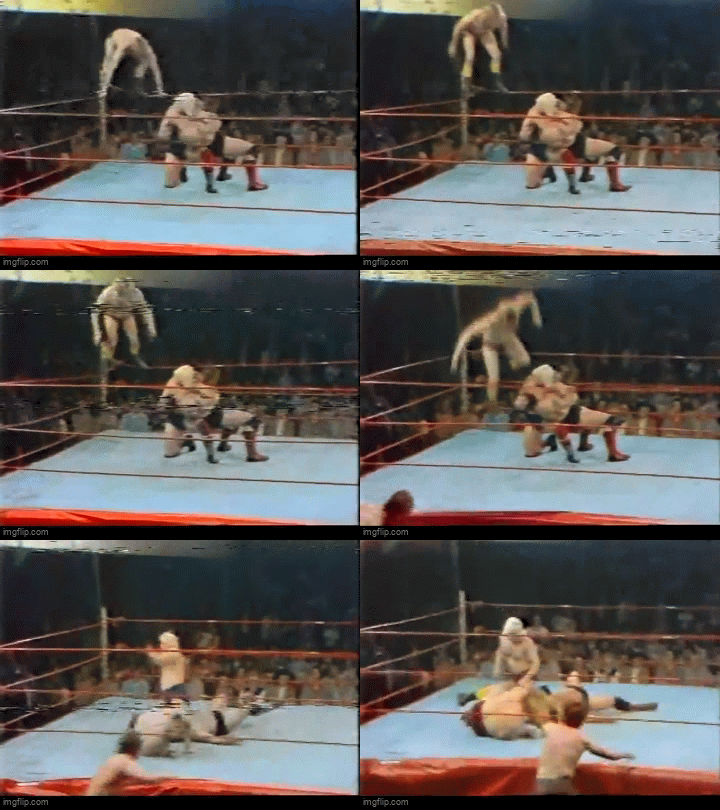
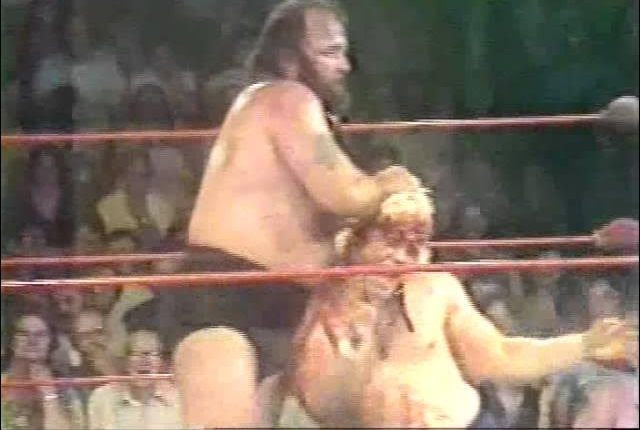
This is also the final available Portland footage we have of Mayne, who dies the following August in a single-vehicle car accident. His manic, reckless-looking style is on display here, both in the ring and later on the mic. Wiskowski Irish whips Lonnie into a neutral corner, and Mayne takes a wild-looking bump to the floor, then comes up bloody. Back into the ring, and Wiskowski unloads on Mayne with a series of diving headbutts (I counted six of them). Rose and Wiskowski aren’t through and start swinging on everyone, including both referees. A melee ensues, during which Mayne opens up an absolute gusher of a cut on Rose. By the time the fight breaks up, Mayne and Bass (and Savage, for some reason) are standing tall while Rose looks like a murder victim.

Frank interviews both teams from his crow’s nest, and we get some of the best promos yet of this time period. Promoter Don Owen sets a rematch for the tag titles on Tuesday, and raises the stakes to make it losers leave town. Rose is absolutely covered in blood for this interview, and it really adds to the interview as Rose and Wiskowski rant and rave at this latest outrage perpetrated against them by management. Frank Bonnema then has an all-timer of a segue to the commercial between interviews, observing the blood that thoroughly coats the floor and then noting “You can clean up if you’re looking for a used car.”

Mayne and Bass are next, and Maybe spends the whole interview chewing on and swallowing broken glass. We’ve seen other wrestlers do this and apparently it’s an established part of Mayne’s schtick because it’s treated with a sense of impending doom, as if to say … “Lonnie’s not screwing around, he’s got the glass out again!”

Mayne and Bass go on to lose the non-televised rematch and cycle out of the territory.

There’s not much meat here as far as the wrestling action, but the blood and chaos and good interviews make for a highly enjoyable watch.

December 10, 1977

All we have from this episode is the second and third falls of the main event. Rose and Wiskowski, tag champs once more, take on Skip Young and Jimmy Snuka in a non-title match. Snuka is another guy who came into Portland several times in the 1970s and, as mentioned on a previous episode, now is going by his “Superfly” moniker. A review of results from 1977 show that Snuka has been in the territory for almost a month on this current run, but this is the first in-ring footage we have.

Snuka spends most of this on the apron while Skip does the bulk of the work and the selling for Rose and Wiskowski. When Snuka does tag in, the heels make him look like a million bucks. Wiskowski takes some big bumps from Snuka when he makes the tag in the second fall, which ends shortly thereafter to tie the match on a slick quick pin by Skip. In the third fall, another hot tag to Snuka sees him put away Rose in fairly short order with the “Fiji Island Full Nelson.”

Rose’s selling is consistently great but he sells beautifully in this match and the following interview. He projects an air of grievance that permeates his words, facial expressions, and physical reactions. It’s as if the world is against him in Portland wrestling, and Rose has to suffer for it almost weekly as a result. A couple of moments I particularly liked… A brief beat between falls where, on his way to the locker room, Snuka pops Rose as he leaves the ringside area and Rose sells it as if he’s just been seared in the face with a hot iron. Then after the match, an anguished Rose seeks out comfort from Wiskowski. Sporting a large bandage on his forehead that is likely the consequence of his artery tapper last week, Rose proclaims “They’d have had to kill me to make me give up” had the titles been on the line. The heels then engage in some casual racism — mostly from Wiskowski, sheesh — before a title match gets set for next week’s TV program. Sadly, footage of that one appears lost to the sands of time.

So 1977 is in the books, and there’s little debate that Buddy Rose is the MVP of the territory. If you are not familiar with Rose, I highly recommend seeking out some of the footage in this and prior installments to get a feel for his matches, his persona and the general atmosphere of Portland wrestling.

Up Next: We tackle what little footage that exists from 1978 in one single review.

Review the Kraken: I Love It When A Plan Comes Together

Review the Kraken: I Love It When A Plan Comes Together

Telling a long-term story in pro wrestling is not easy, especially at the independent level. Injuries, politics or flaky talent can disrupt even a rather simple plan.

Kudos to Kraken Pro Wrestling. then, for pulling it off.

Kraken’s one-year anniversary from May of 2025, the Kraken Classic, also represented the culmination of a one-year storyline. At the first Kraken Classic, Jay 2 Strong won the tournament to become the first-ever Kraken Champion, then bequeathed the championship to his manager, Justin Kayse, the leader of The Business. Kayse held the title for a year and never defended it. Instead, he used members of The Business as proxies against any aspiring challenger. Win against one of The Business — first Jay, then Dominic Stuckey – and earn a three-minute match against Kayse for the title. Except actually reaching Kayse was a hurdle that no one could clear. Kayse went a full year and never had to actually defend the title, mostly due to trickery and shenanigans by him and the members of The Business.

In this review, we tackle the culmination of that storyline, which came with an incredibly satisfying payoff.

It took a long time for me to fully digest this review to the point where it coalesced as a written piece for me. Part of that is that I’ve been busy writing about other things, both here and elsewhere. I’ve also been busy on the family front. And the work front. I also wanted to make sure I did justice to all the work that went into building what I consider the “season 1 finale” of Kraken. Not just the traditional concept of work as it pertains to wrestling and what happens in the ring. Work in interviews and backstage segments and commentary to develop characters and drive the story. Hopefully, this end result reflects and honors the amount of work that went into this climactic chapter.

With all that said, let’s dive right into the review.

Episode 50

The final match of the Kraken Classic puts Charlie Kills against Lamar Diggs after each won a four-way match earlier in the taping. Charlie has shaken up his usual look, and I’m getting Spoiler vibes — in a good way — from the red mask. Charlie has leaned increasingly into his “friendly neighborhood maybe-a-serial-killer” persona in Kraken. I greatly enjoyed the little touches here: the fish hooking, the joint manipulation, pulling on Diggs’ nose, and even an ankle stomp.

Diggs is also a favorite of mine on the Kraken roster. He’s the most physically imposing wrestler on the entire roster and he sells well. Diggs busts out some great facial expressions in this one. Meanwhile, he goes deep into the ol’ moveset. He uses some open-handed palm strikes to break a submission hold by Charlie, and later, I certainly didn’t expect a cross face out of the heavy hitter of The Business. Diggs wins out of nowhere with a flash pin, flipping forward out of a double leg bridge (the big guy is nimble!) and perfectly planting his feet on the bottom rope for the extra leverage. I cracked up after the match when Diggs is holding up the Kraken Classic trophy with one hand and a screaming child with the other. This was a very good match that was well worth seeing, and having Diggs win the tournament — and the guaranteed shot at the Kraken Title — scoops some extra drama onto the Aeom-Stuckey match, and the prospect of The Business having total control of the championship scene if Aeon falls short.

This is a very good match that is worth seeing, and also an important plot point if you’ve been following Kraken from week to week like I have. There is untapped potential for both Diggs and Charlie coming out of this tournament. I still look forward to the potential day when Diggs and Kayse split, and Diggs is able to get his hands on the manager.

A few other notes… The camera work here in this match shows how full the crowd is, and it’s a pretty packed house. The commentary could have been better. Diamond Duke goes back to complaining about the speed of the referee’s count, because it’s anytime. Meanwhile, the “Make a name for yourself!” line by Donnie Harris before a near-fall pin by Charlie. Note to self, guys and girls… not every wrestler is Jeff Hardy in a ladder match with The Undertaker from 2001.

Episode 51

This might be my favorite episode yet of Kraken TV. in the entire run. Kevin Kantrell is one of the MVPs of the promotion and he takes center stage in this episode. He has a good interview with Kay Casiano. We then get a “hidden camera” segment backstage involving ERC and Brandon Whatley, where, maybe for the first time in televised wrestling, the hidden camera actually makes logical sense.

Those were the appetizers. Let’s dig into the main course, the one-on-one match between Kantrell and Joe Black. I’ve known Joe for more than a decade and seen him evolve, grow, and change as a wrestler but more importantly as a character and a presence. He’s a guy I always felt warranted an opportunity on a larger stage. Maybe one day …

There’s a big fight feel for this match. It’s Joe’s debut in Kraken but previous episodes have done a good job establishing him and he already feels like a rather well-known quantity even before the bell rings. Some people reading this are going to roll their eyes at the comparison I’m about to make, but the way Joe carries himself during this match reminded me of Samoa Joe during his run as ROH Champion, which I mean as quite a high compliment. Joe is here for a match and a payoff; he’s also here to test the mettle of Kantrell and see how good he truly is. The actual wrestling here is quite good, and though these holds and exchanges are things a longtime wrestling fan like me has seen a thousand times, they crackle with intensity. Meanwhile, audible trash talk by Joe during the match is the fuel that propels the narrative. The announcers diminish their presence so these words can be heard clearly on the footage.

After an initial hold-for-hold exchange, Joe dismisses Kantrell as “light work.” Later, when they transition from mat wrestling to striking, Joe taunts Kantrell as a “big fish in a small pond”, goading Kantrell to administer a forearm but instead poking Kantrell in the eye — a bait and switch that I enjoyed immensely — before the blow can be delivered. When Joe follows up with some wicked-sounding chops in the corner, Kantrell piefaces Joe in response in a tremendous distillation of his defiance and resolve.

This feels like more of a back and forth match than the traditional structure with heat and shine. At one point, and I’m not sure if it was intentional or not, Joe busts out a bridging variation of the Mutalock — the same old Kantrell used to tap Will Huckaby (Joe’s longtime friend turned nemesis) at the end of 2024. A spinning forearm is delivered with a healthy amount of strong style. Kantrell unleashes an Avalanche Samoan Drop. Later, Kantrell strings together an Alabama Slam into a Styles Clash, leading to a convincing near-fall where both men’s shoulders are down — a detail I wish was made more of on commentary. The payoff comes when Kantrell delivers a brain buster, then rolls into his cross face hold to force Joe to tap. In the aftermath, Joe offers a handshake to Kantrell — the same gesture Kantrell offered and Joe refused in a backstage interview from earlier in this taping.

Tremendous.

Episode 52

This episode, the finale from the Kraken Classic event, is all about Justin Kayse and his ill-begotten Kraken Title reign. With Diggs winning the tournament earlier, it’s positioned — and rightfully so — as a last-chance, all-or-nothing scenario if there is to be any integrity at all in the championship scene. The episode begins with the contract signing between Aeon and Stuckey from earlier that day, which I mention only to note the moment where Donnie — who doubles as GM and lead commentator — mentions he wouldn’t mind seeing Dom as champion one day and Stuckey flashes a brief but very purposeful glance at his manager and the title slung over one shoulder.

Kay Casiano brings it up a notch on her introductions for this one, and once again a big-fight feel is established right off the bat. Once again, the rules here are that, if Aeon beats Stuckey, he gets a three-minute title match with Justin Kayse. The Aeon-Stuckey match is also no disqualification. The two combatants lean right into the stipulation, starting out hot with back-and-forth blows and then spilling to the floor. Kraken doesn’t do brawls outside the ring very often (Huckaby and Diggs had a memorable one way back) so it stands out when it does happen. Aeon pursuing Stuckey around the ring on all fours is a nice, novel touch.

I don’t think it’s possible for me to pick just one favorite wrestler on the Kraken roster, but both these guys are in the conversation. Stuckey really shines in this match with his facial expressions and trash talk. The no-DQ stipulation flows in both ways. Aeon takes Kayse’s loaded briefcase across the back, then spills to the floor to really get the heat of the match boiling. Then, when Stuckey puts Aeon in a modified cross face looking for the submission, Aeon pulls Kayse into Dom to break up the hold. Justin Kayse oversells this fairly modest impact like he’s been hit with a tranquilizer dart, to my profound amusement.

Dom follows up with a package piledriver (I added a couple of exclamation points to this in my live notes), but Aeon kicks out strong. Dom doesn’t like it, confronts Referee Clark, and decks him. Aeon hits his finisher, and here comes Referee Pee Wee, only to have Kayse wallop him with the briefcase. We’re out of referees… and that means the chaos begins.

This taping had The Business referring to a “Plan B” for this match throughout, and Jay 2 Strong looks to be the cornerstone of that plan, running in and blasting Aeon with a superkick. What proceeds is a long-running series of run-ins involving every wrestler on the card. Sometimes they come out one at a time, sometimes two at a time. On each occasion, the new entrant to the chaos drops whomever came in right before, a quick-hitting, lengthy series of interference spots that I won’t dare to attempt to recap in full here. The sequence does get a little wonky at times and reflects the overall population imbalance between fan favorites and rulebreakers on the roster, as there are a few instances of babyface-on-babyface-violence during the series of run-ins. The crowd, however, loves every bit of it.

The run-in parade eventually circles all the way back around to Jay, who goes to superkick Aeon and hits his stablemate Dom by mistake. This single moment escalates everything. The crowd goes wild. Babyface wrestlers surround the ring and are banging on the apron as Jak Myles dispatches Jay with a Russian legsweep (because he’s the Sweeper, you see), and then, Superman-style, sheds his coveralls to reveal referee gear underneath, calling back to the very first Kraken tapings where a down on his luck Sweeper had to referee matches as well for extra money. Aeon hits his finisher again on Stuckey and Sweeper counts the pin, to an absolutely insane crowd reaction. For a minute there, I thought I was watching mid-1980s Jim Crockett Promotions. (Tip of the hat to Diggs, who timed it so he was oh so close to breaking up the pin).

The focus immediately shifts to Justin Kayse, who goes running out of the building. He’s pursued, and there’s a fantastic visual where several of the fan favorite wrestlers carry a protesting Kayse back into the arena and dump him into the ring. Now the ring is entirely circled, with wrestlers and fans pounding on the apron. In another nice touch, Diggs and Jay are being held back on the floor so they cannot interfere. Kayse offers Aeon a literal fist full of dollars to try and avoid what’s coming. Diamond Duke, who roots endlessly for The Business on commentary, is apoplectic throughout all of this.

Aeon answers Kayse’s bribery offer with controlled violence. He destroys Kayse with two moves and is quite safe with him in the process, especially considering Kayse is a non-wrestler. Sweeper counts the pin, and there’s another eruption from crowd and commentary alike as the Justin Kayse reign (of terror?) comes to a definitive end.

Final Thoughts

I can’t count the number of times I see or hear someone explain that a wrestling outcome is “predictable.” Some of the best stories ever told, in various mediums, have a predictable conclusion. Even if you see the final destination coming from miles away, the joy comes in the journey, and the precise route taken to reach the end point.

These three episodes represent Kraken at its greatest heights to date. The final two episodes, featuring Kantrell vs. Black and the Aeon-Stuckey-Kayse drama, stand head and shoulders above anything the promotion has done. Which one is better? I would say that the Kantrell-Black episode has more of a standalone element of quality; you can enjoy it thoroughly without having any significant context or prior knowledge or viewing of Kraken. The final episode from this taping, however, feels like the last chapter of a long, compelling book you’ve spent quite some time reading through. If you’ve been following along this whole time like I have, there’s a satisfaction in the conclusion that can’t be reached without knowing all the players, twists, and turns that led to that moment.

Check out all three episodes, embedded below:

From the Crow’s Nest: November, 1977

From the Crow’s Nest: November, 1977

Welcome to the third installment of From the Crow’s Nest, a series of articles looking back at Pacific Northwest Wrestling and the history of wrestling in Portland, Oregon.

In this week’s installment, we cover available footage from November of 1977. Most of the footage comes from a pair of episodes, two weeks apart. You can find everything in this installment on YouTube and I’ve embedded a playlist at the bottom of this article.

November 5, 1977

We’re two weeks removed from the rather fantastic angle and turn involving Sam Oliver Bass (aka Ron Bass), Buddy Rose, and Ed Wiskowski. Bass and Rose faced each other on last week’s episode, which is not available, but we get this entertaining rematch., which also recycles the trope of Rose wrestling a match with a fan favorite positioned as the special referee, although Dutch Savage isn’t nearly as entertaining in that role as Jonathan Boyd was for Rose’s match with Jay Youngblood back in September.

Savage promptly kicks out Wiskowski from ringside, on the threat of disqualifying Rose if Ed doesn’t skedaddle. Bass focuses in on the left arm of Rose, who submits to what Frank Bonnema calls an arm scissors. Rose gets minimal offense in this fall, it’s minimal. He spends much of the fall begging off and running away, which only serves to make Bass come off that much stronger.

After the usual mix of live-to-tape and pre-recorded commercials for sponsors (Tom Peterson has 20 Monte Carlos on the lot for $5,400 each!), Bonnema interviews Wiskowski, who has a match on the upcoming loop against Savage for the heavyweight singles title. What ensues is a very good example of how to do a promo as a confident and arrogant heel wrestler without making your foe look weak.

Rose comes out for the second hall and honors the wrestling gods by still selling the arm. He’s back to stalling and running away, before finally getting the upper hand in Bass after a spot you’ve seen thousands of times: the heel lures their foe into a chase around the ringside area, then cuts off his opponent when they go back into the ring. Rose targets the back of Bass and levels the match on his version of the backbreaker, which has been established in Portland as a strong finisher.

Between falls, Bonnema interviews the plucky babyface duo of Skip Young and Gino Hernandez. I found it interesting that, to me, Gino comes off like a long-lost member of the Von Erich family in what footage of him exists from Portland.

The third fall is brief and high energy, like many of these best of three falls main events tend to be as the show is usually running short on time by this point. Bass kicks out of another backbreaker by Rose and makes his comeback, capped by a punch with some extra mustard that Rose sells with his trademark slipped-on-a-banana-peel bump. While Savage scolds Bass for the punches, Rose comes up bleeding. The match ends shortly thereafter, with Wiskowski coming out to attack Savage and add some heat to their upcoming title match.

This is all pretty good, but we’ve already seen much better so far in this project.

After the match, Savage heads to the crow’s nest and tells Bonnema he’s putting Rose in a cage match against Bass the coming Tuesday. He cites “Don Owen’s power of attorney.” Bonnema’s subsequent verbal gymnastics to justify a wrestler having the authority to book this match come off pretty funny, which is likely not the intended effect. Rose’s reaction is pretty great — full of bloodstained outrage as Wiskowski proclaims, “he is a human being!” The promo work by the heels is good enough to make me wish that footage of the cage match existed.

November 19, 1977

The video quality of this episode is pretty poor, so be prepared.

It’s been a busy two weeks in Portland. Wiskowski has dethroned Savage as the heavyweight champ. Bass and Anson remain the tag champs, but in footage from this episode that apparently has been lost to the sands of time, Anson suffers an injury that’s going to put him on the shelf. This plot point anchors what footage survived from this week.

The main event is a rematch of last month’s great bout between Rose and Mayne. This is still good but doesn’t come close to the energy and crowd heat of the October match. After Mayne wins a pretty straightforward first fall with his flying knee drop, which does not evoke vomit this time — Rose just sells like he’s dead — Bonnema reviews the upcoming seven-day (!) loop.

Next we hear from Bass about the tag title situation. He’s down a partner now and championship matches have been booked on the upcoming loop. Bass’ straightforward, relatable delivery works here.

This is an outlier main event for Portland, as it ends in two straight falls. There’s some noteworthy improvisation that takes place around an equipment malfunction, when Mayne fires Rose across the ring and the impact breaks the top rope. Each wrestler attempts to use the dislodged turnbuckle against the other. Rose wins the fall with his back breaker but stays on the attack, to the point Sandy Barr disqualifies Rose and reverses the decision. Bass comes to make the save for Mayne, so you can probably guess where things are leading.

There’s still time in the episode so we get some filler content. First up an interview with Savage, who becomes more unlikable the more footage I watch of him. He engages in some very dry mockery of Anson for his injury, shits on the San Francisco territory, and then starts talking about his son’s high school football team.

These episodes fall into a certain predictable rhythm. As part of that rhythm, Bonnema has one or two plugs a week about how to get tickets. He seems borderline frustrated at having to explain time and time again, but I find it charming how the best way to get them is to go to the referee’s stand at the flea market.

Next, Gino Hernandez wrestles Skip Young in a standby match which, if you’ve watched old wrestling previously, usually means that the competitors go out there and durdle until the time limit expires. This match follows that pattern. Even Bonnema can’t disguise his boredom, referring to the usually vocal Portland Sports Arena crowd as “quiet but enjoying.” This is a snooze for sure, but at least the matchup is unique.

We conclude with Mayne joining Bonnema in the crow’s nest, only for Bass to interrupt and ask the Moondog to be his partner. As simple as much of the storytelling in Portland can be, there’s no attempt to insult the audience’s intelligence. Bass openly acknowledges the past hostile history with Mayne, saying “I thought this day would never come.” Mayne dons Bass’ cowboy hat as the answer, and we’ve got a new tag team.

Up Next: We wrap up 1977 with a look at the available footage from December.

Miss Something?: Check out the full index of articles in the From the Crow’s Nest series.

From the Crow’s Nest: October, 1977

From the Crow’s Nest: October, 1977

Welcome to the second installment of From the Crow’s Nest, a series of articles looking back at Pacific Northwest Wrestling and the history of wrestling in Portland, Oregon.

In this week’s installment, we cover available footage from October of 1977. It’s a pretty good haul for this month, with at least some footage from three out of four episodes in the month from the Saturday night Portland TV show. Most of the footage is on YouTube and is embedded at the end of this article. The video quality on some of this is pretty poor, but the action holds up.

October 1, 1977

Gino Hernandez vs. John Anson

We pick up in the early stages of a match between Anson, who is one half of the tag champs with Sam Oliver Bass (you know him better as Outlaw Ron Bass), and a very young Gino. This is, to my knowledge, the earliest existing footage of Hernandez and seeing him as a plucky young babyface is quite the change of pace considering he’s best known from his years as an arrogant heel for various promotions in Texas.

Like the two out of three falls match between Buddy Rose and Jay Youngblood, a good bit of this match is based around the headlock — only there’s far less sizzle as this encounter lacks both the crowd engagement or the type of selling Rose does in the hold. I wouldn’t call this a good match, but it’s decent and gets significant time. It feels like desperation when Anson starts throwing headbutts, and at one point the two start trading fatigued punches from their knees. Gino comes close to scoring the win a few times, reminiscent of a modern-day New Japan match with a young lion going against a wrestler on the main roster. Hernandez and Anson go the distance, and in the aftermath, commentator Frank Bonnema waxes on how much wrestling in the territory has improved in the past decade.

2/3 Falls: Lonnie Mayne vs. Buddy Rose

This is, in my opinion, the first great match in this project. What makes it great? It encapsulates the entire style of the promotion, and, to a greater extent, wrestling in the 1970s. It’s gritty, brutal, and bloody. It also matches up the territory’s biggest fan favorite in Mayne against Rose, unquestionably the most hated man in Portland.

There’s a story here, and you don’t need to have a literature degree to understand it. Rose has kept hurting other wrestlers in the territory. Mayne, who was friends with many of those injured, wants revenge.

Mayne and Rose get right down to business, with Rose trying for a cheap shot while still wearing his entrance robe. Mayne cuts him off and Rose pays the price. Mere seconds later, Mayne launches off the top with a nasty-looking flying knee drop that catches Rose square in the stomach for the pin to end the first fall. Rose doubles over and vomits in the ring after the fact — which is either proof that knee was very snug or a supreme moment of selling by Rose to be able to vomit on cue. I don’t know which is true, and I actually enjoy the uncertainty.

The little touches elevate what happens between the ropes. In the introduction to this series, I wrote about the unique setting of the Portland Sports Arena, with many fans who come out every week for the TV shows. This creates a level of investment from the crowd that is hard to replicate and even harder to truly explain unless you see it for yourself. After the first fall, Mayne picks up some little girl on his way back to the locker room and no one bats an eye at it. Heading into the second fall, one of the several old ladies who sit in the front row starts chasing Rose around the ring with her cane. Then Mayne takes her cane and tries to use it on Rose. After Rose takes the second fall, bloodying Mayne in the process, fans flock to Mayne as he sits slumped in the corner waiting the third fall; encouraging pats on the back ensue and someone even offers Mayne their drink.

By now, blood (and vomit) have been spilled, creating a heat and hatred for the third fall that feels visceral. A mistake by Rose leads Mayne to attack his arm, looking to make good on last week’s vow to break the arm of the Playboy. Mayne is so relentless that he shoves and then punches referee Sandy Barr when he attempts to intercede, getting himself disqualified. The attack continues around the ringside area until Rose retreats to Bonnema’s crow’s nest broadcast position. I enjoyed this quite a bit, while the main purpose is to serve a street fight rematch between the two a few days later that, sadly, was not televised.

October 8, 1977

Buddy Rose vs. Cocoa Samoa

This is a rematch from their TV bout back in August. Rose does his best Gorgeous George impression in the pre-match, meticulously folding his T-shirt as part of an extended stall. Cocoa ensnares Rose in a headlock and wrenches on it, like Youngblood did last month. Once again, the way Rose sells this is everything. When Cocoa takes down Rose, the Playboy tries to reverse into a pin with a handful of tights but the granny at ringside is on the case, hollering at the referee. Rose attacks the arm of yet another opponent and hooks what looks like a modified kimura to get the submission. Neat.

Mayne is set to wrestle Ed Wiskowski, Rose’s partner, in the main event but that match is absent from the surviving footage. What we do get is a 10-man battle royal for $1,000. Considering that promoter Don Owen tended to maintain a tight crew, this is probably the entire active roster in Portland at that time. The highly invested crowd makes this a fun watch and Gino Hernandez gets a chance to shine as one of the final wrestlers left standing — and takes a pretty spectacular plummet to the concrete floor on his elimination.

October 22, 1977

Dutch Savage, Lonnie Mayne & Skip Young vs. Buddy Rose, Ed Wiskowski & Sam Oliver Bass

Frank Bonnema sets the scene, mentioning some issues between Bass and Rose when they teamed together at a recent event. The theme of dissension is established and plays out in what looks more like a comedic farce on stage than a wrestling match at times. Rose and Wiskowski leave Bass hanging to start the match and, on two occasions in the first fall, Bass gets drilled by mistake by one of his partners. Later, when Savage is working over Bass’ left arm, Rose and Wiskowski deliberately pull back as Bass reaches for the tag. The crowd hoots, hollers, and applauds with delight at each of these moments, and Bass’ facial expressions and body language project his increasing sense of frustration and fury. Despite all the issues within their team, the rulebreakers score the first fall when Wiskowski catches Skip Young with his diving headbutt, a strongly established finishing move in the territory.

After the usual round of live-to-tape commercials between falls (buy a Pinto for $1,000!), we’re back and the dissension between Bass and Rose and Wiskowski continues. Another miscue — this time Rose accidentally dropkicking Bass — leaves him prey to get pinned by Skip and even the match at one fall apiece. The heel team falls apart, with Rose and Wiskowski assaulting Bass. What had, to that point, been played often for laughs turns deadly serious as Bass gets turned into a bloody mess.

Make that a very bloody mess.

It’s an effective beatdown, showing there’s no honor among thieves for the heels in Portland — or, at least, when it comes to Rose and Wiskowski. The break between falls really gives this attack time to breathe. Bonnema interviews Mayne, whose disgust at what happened to Bass adds extra zest to a delicious bit of business. I also greatly enjoyed the little touch by Rose before the third fall, smearing Bass’ blood into the mat with his boots. The third fall is reduced to a straight two on two tag, with Savage and Skip the opposition, and time expires fairly quickly in the fall. That’s all precursor to the post match, when Rose and Wiskowski go to the crow’s nest for an interview and a blood-soaked, bandaged Bass attacks! The crowd is molten hot for this as Bass slams Rose on the wooden commentary desk. Bass is out for blood and vengeance and demands a match with Rose on next week’s episode. The footage of that is unavailable, but it makes you want to tune in next week regardless, and isn’t that the point of any wrestling show — or TV show, period?

Somewhat lost in the shuffle of this blood-soaked tale of dissension: this is the debut in the Portland footage of Skip Young. When you think about wrestlers from prior decades who would have succeeded in the current era, Young definitely classifies. I could see him being a great fit for any modern promotion. He gets a few months to shine here: most notably, in the short second fall, when he busts out an impressive high leapfrog, then a sweet standing dropkick, and kips up ready to keep bringing the fight. Unfortunately, there’s not a lot of Skip Young in this territory, but some enjoyable matches lie ahead nonetheless…

From the Crow’s Nest: September, 1977

From the Crow’s Nest: September, 1977

Welcome to the second installment of From the Crow’s Nest, a series of articles looking back at Pacific Northwest Wrestling and the history of wrestling in Portland, Oregon.

In this week’s installment, we will cover available footage from September of 1977. Most of it’s on YouTube and is embedded at the end of this article.

2/3 Falls,: Jay Youngblood vs. Buddy Rose, 9/10/77

The September footage is anchored by two matches between Rose, a Portland mainstay, and Youngblood. Jay is best known for his time in Mid-Atlantic Championship Wrestling — especially teaming with Ricky Steamboat in The Final Conflict cage match that’s widely considered the predecessor to Starrcade. He’s still in the fairly early stages of his career here.

Both Rose and Youngblood are entertaining in the ring, and this matchup doesn’t disappoint. However, the special referee that’s “assigned” adds an extra level of enjoyment. That referee is Lord Jonathan Boyd, another Portland fixture. Boyd was in and out of the territory throughout the 1970s, primarily as a heel and often teaming with Norman Frederick Charles III in The Royal Kangaroos, a team that borrowed its gimmick and base name from The Fabulous Kangaroos, maybe the first great tag team in wrestling. Boyd also was part of an iteration of The Sheepherders, who begat The Bushwhackers in WWF.

But I digress … Boyd is a fan favorite in Portland by 1977, and when he’s revealed as the referee, the crowd loves it while Rose throws a fit.

We’ve all seen matches with a special referee, but the lengths to which Boyd goes to chew the scenery — and officiate being entirely one-sided for Youngblood — truly go the extra mile. Every count that Boyd makes on Rose, be it for a pin or being outside the ring or even in the ropes, is rapid fire. Later, when Rose grabs a handful of Youngblood’s trunks, Boyd twists Playboy Buddy’s thumb to break the hold. The capacity crowd in the Portland Sports Arena cheers and laughs along throughout, creating the atmosphere more akin to a theater audience watching a farce on stage than a wrestling match. The fans are also red hot in their support of Youngblood, and their hatred for Rose. A “We Want Jay!” chant bellows through the building on a few occasions over the three falls.

There are certain sports and sequences that were pretty standard in wrestling years ago that have fallen by the wayside in 2025. The criss-cross is one of them, and Rose and Youngblood bust out a high-speed version of it here. Rose busts out a couple of nice leapfrogs during this, showing the athleticism that a lot of people might overlook from his frame and physique. Jay ensnares Rose in a sunset flip and scores the pin on a three count Boyd makes in less time than it took me to type these words (and I’m a fast typer).

Now we go to the content between falls, which is part of the retro charm of these episodes. It starts with commentator Frank Bonnema, whose outfit tonight is an epic example of late 1970s fashion.

Other highlights that a modern viewer might find fascinating:

  • A plug to get tickets to the next taping of Portland TV, either at the concession market or visiting the flea market stand run by Sandy Barr, a referee for the promotion. And today people wait in angst in a TicketMaster queue …
  • The sponsors then take their turn. On many Portland episodes, these were live-to-tape commercials, and we get one of those here from Friendly Chevrolet. Granted this was almost 50 years ago, but the prices are mind-boggling in this era of soaring costs. $5295 for a truck! $5695 for a truck with four-wheel drive and a V8 engine! A 77 El Camino for $5595!
  • Bonnema also shares the schedule for the next week of shows in the Pacific Northwest… and there literally are no days off.
  • We also get a delightful interview with fan favorites Lonnie Mayne and Dutch Savage (the latter was also a longtime booker for the promotion) where Bonnema reads a letter presumably from a 91-year-old widow who wants to help Mayne run out all the rulebreakers from the territory. Adorable.
A sample week of shows in Pacific Northwest Wrestling in September of 1977. Wrestlers, especially those still learning the business, sought out that territory for the busy schedule and better paydays.

Around all the schtick with Boyd, Youngblood and Rose work the bulk of this match around the side headlock, usually with Youngblood ensnaring Rose. The crowd is so loud and engaged that they buy right in when Jay goes right back to the headlock and he starts wrenching on the hold, as the crowd counts along! Rose, meanwhile, is paying homage to the Wrestling Gods with the way he sells the hold, slumped against Jay and hanging lifeless like a limp dishrag.

In the first fall, Rose shot Youngblood off into the ropes to counter the headlock and initiate the criss-cross that led to the pin. Rose tries again, but learns from his mistakes and counters with a fine-looking backdrop on Youngblood. Bonnema, who does a quality job as a TV host and brings a late-night DJ vibe to his commentary, calls this a “shoulder throw”, for reference.

Rose focuses in on the back, then finishes Youngblood using the same back suplex into a backbreaker that he used to beat Cocoa Samoa in the first installment of our series of articles. For the record, it still looks like something from the Roderick Strong arsenal of moves. Boyd is still in full schtick, making a very deliberate and slow three count. Rose demands his hand be raised, and Boyd ignores it … but he does make sure to stomp on Rose’s hand when the Playboy starts pounding the mat in frustration.

Another between-fall break with commercials and live-to-tape advertising, which includes a razor commercial that must be seen to be believed. There’s also some footage of Jimmy Snuka, who’s promoted as making appearances in the territory that coming week and shows up in surviving footage from the end of the year. The best part of these clips for me is that legendary wrestler Danny McShain is the referee for one of the matches.

Before the third fall begins, Bonnema interviews John Anson and Sam Oliver Bass (you probably know him better as Ron Bass), the current tag champs in the territory. Bass and Anson are set for a death match tag that same night that won’t make TV, and Bonnema urges fans to check their newspaper for the results. Weird, wild, and very different times …

The third fall is joined in progress and time is running out on the show. Rose takes control but every pin attempt is met by another glacial count by Boyd. The Playboy snaps and starts stomping Boyd, who comes up swinging off the mat to the unfiltered delight of the crowd. The opening salvo of blows ends with Rose getting sent flying in that style of bump I wrote about in the first installment of the series. The blood starts to flow from Rose’s head and Boyd continues to hammer him as the footage ends.

This is a Very Good match that you should go out of your way to watch. The final two falls are available on YouTube, but definitely track down the first, which also is available online if you know where to look, because of all the antics with Boyd’s biased officiating serving as a method to torment Rose. Yes, the third fall is rushed, but it also shows how Rose had just reached his tipping point. All told, the match weaves a compelling and entertaining story with several well-executed bits of humor. You just don’t see wrestling like it today.

Jay Youngblood vs. Buddy Rose, 9/24/77

This match is on the undercard of this TV broadcast, so it’s just one fall and what ensues is more of an angle than a match. To be fair, it’s a good angle, as Rose and his running buddy Ed Wiskowski injure Youngblood’s left arm. This is just the latest victim for Rose; on commentary early in this footage, Bonnema refers to Boyd getting taken out of the territory by the Playboy. There’s a nice bit of misdirection as the match begins with Rose distracting Sandy Barr while Wiskowski, who is seconding Rose, grabs Youngblood’s leg and wrenches it from the floor. Rose focuses a relentless assault on Youngblood’s left arm, to the point Mayne runs in for the save and removes his own boot to club at Rose. Sandy Barr eats shit to the floor during the chaos and, in one of my favorite bits of this, ringside fans go to help him up.

Jay really sells the attack and injury. He’s got a cut dripping down the injured left arm and is alternating between writhing in pain and screaming. The camera stays right with the scene and that hot capacity crowd in the Portland Sports Arena watches in a hush. Mayne and Jay’s older brother, Rick Youngblood, are out to help Jay to the back and he collapses while they’re in transit. Fantastic.

After another car commercial (all the vehicles for sale have AM radio, you guys!) Bonnema interviews Mayne from the Crow’s Nest. Moondog Lonnie vows vengeance and that he’ll break Rose’s arm next week the way Rose has done to so many. Mayne is wild and fiery here. He also lived hard; he’s 33 here and this footage is filmed less than a year before his death, but he looks 50. Given what I’ve read about Mayne’s life, when he drops his “There’s excitement in the air!” phrase, I can’t help but wonder if the excitement and whiskey have the same aroma.

As for the Mayne vs. Rose match? It will kick off the next article.

Check out the introduction to this series.

From the Crow’s Nest: Introduction, and a 1977 Exposition

From the Crow’s Nest: Introduction, and a 1977 Exposition

Welcome to From the Crow’s Nest! This will be an ongoing series of reviews looking at the history of wrestling in Portland, Oregon … specifically Pacific Northwest Wrestling.

The history of Portland Wrestling goes as far back as 1925 (we won’t go that far back), but it’s best known for the multiple decade run under Don Owen, whose father, Herb, founded the promotion.

The Portland territory was unique, in a few ways.

  1. It was small. Owen usually kept an active roster of just 10 to 12 wrestlers, and worked a busy loop of shows in Oregon, Washington, and British Columbia in Canada. You’ll see this on some of the TV segments where they break down the upcoming calendar.
  2. Because of the small roster, episodes of Portland’s TV program had a structure that was unique but also seems a perfect fit for a television show. The main event of most episodes was best two out of three falls. Between falls, wrestlers typically went back to the locker room, and during these brief intermissions, they would either hold interviews with wrestlers or cut to commercials with sponsors. It’s a hoot watching the latter, and seeing both the style of the time and some of the prices that seem insanely low, especially by 2025 standards.
  3. Portland’s TV program was an institution in the region. Owen ran his TV every Saturday night out of the Portland Sports Arena — a renovated bowling alley that the promotion owned. Eddie Graham followed a similar tact in Florida, running his promotion out of a building he owned. The show aired live — and then, live to tape — on KPTV Channel 12 in Portland for decades, on nothing more than a handshake deal.
  4. The crowds, at least on these initial episodes, were red hot. Owen offered “season passes” to the TV tapings, which, combined with the regular loop of towns, forced his wrestlers to shake up their routine and not work the same kind of match time after time. “The first several rows of ringside, you couldn’t buy a ticket, because they were all permanent reservations,” Dave Meltzer once said about Portland crowds to Slam Wrestling. “The first six rows had the same people sit in those chairs for 52 weeks a year for years on end. The only way to get a ringside ticket was if one of them died, you literally had to be in their will.”
  5. The Portland product is, in some ways, a harbinger of what changed in wrestling in the 2000s. The promotion emphasized more smaller wrestlers and a fast-paced style. Owen also had a reputation for paying well, which left no shortage of individuals who wanted to make their way through the territory. Consequently, a who’s who of talent makes appearances in Portland over the years.

With that introduction out of the way, let’s dive right into the footage.

We pick up with what I believe is the oldest existing video from Portland’s TV show.

Lonnie Mayne vs. Jesse Ventura, 5/7/77

You may know the Moondogs more as the tag team that worked throughout different territories in the U.S., but Mayne was actually the original Moondog. He also would have a much larger legacy in wrestling if he hadn’t been lost too soon. He died in 1978 at the age of just 33 in a car accident en route to a booking in California. Mayne worked almost exclusively as a heel in the early 1970s, and challenged Pedro Morales for the WWWF Title at Madison Square Garden. By 1977, though, Mayne was a beloved fan favorite of the Portland Sports Arena crowd. There’s an excellent bio of Mayne at Pro Wrestling Stories if you’d like to know more about him.

In this match, a best-two-out-of-three fall affair as was the custom on Portland TV, Mayne wrestles Ventura, who was at this point a fixture in the territory before going on to bigger stages in the AWA and WWF. The surviving footage starts with the first fall in progress, then jumps ahead to the third fall, with no finish. Mayne had a reputation for being wild in and out of the ring; at one point, he heads to ringside and throws a drink in Ventura’s face. One punch later and Ventura goes sprawling to the floor.

Between the ropes, Mayne was rather fearless. In the third fall, he takes a variation of what I know best as the Harley Race bump to the floor: hooking his feet on the ropes then dropping down on his head. As if the beverage wasn’t enough, Jimmy Snuka — another wrestler who became a regular in Portland in the 1970s before moving to bigger stages — comes to ringside and tosses Mayne a cowbell to start laying waste to Ventura. Somehow, this isn’t a DQ.

This one falls in the Worth Watching category for me. There’s nothing earth-shattering here but the crowd is hot, the action is entertaining, and there’s some significant historic value here.

Cocoa Samoa vs. Buddy Rose , 8/13/77

This is the earliest footage in Portland of Buddy Rose. If there’s an all-time MVP of the territory, it’s probably him. I also think Rose is one of the most underrated wrestlers of all time and, if you follow me through this journey, don’t be surprised if you end up agreeing. Rose can chain wrestle, brawl, and fly. He takes these fantastic heedless-looking bumps, and gives enteraining interviews as a villain who is either talking trash or extremely aggrieved at some perceived injustice. Meanwhile, he has a willingness to bleed buckets that I found endearing. This match with Cocoa is just the tip of the iceberg on the footage of Rose, who personally is responsible for most of the surviving footage from Portland in this era, because he had a habit of recording episodes of Portland’s TV program so he could go back and review his matches.

The video quality is not the best and Portland commentator Frank Bonnema — whose broadcast position is referred to as The Crow’s Nest (get it?) — pooh-poohs what he perceives as a light crowd. Adding greatly to the atmosphere, there’s a granny in the front row who’s vigilant as Rose repeatedly pulls on Cocoa’s trunks while ensnared in a headlock. At one point in the match, Cocoa delivers his leaping headbutt and Rose takes what I consider his signature bump: an explosion of movement where he pushes off with his legs and sends himself flying back to the mat. The landing is more reminiscent of a cartoon character who slipped on a banana peel. It’s ridiculous taken as a snapshot, but it works because it’s so over the top. It’s a regular part of Rose’s matches and it often serves the purpose of making the opposing wrestler’s offense look devastating, which, really, is one of the major points of a wrestling match, isn’t it? Rose wins the match clean with a modified backbreaker that looks like something out of the Roderick Strong arsenal, but the decision gets overturned when he keeps attacking Cocoa, ultimately shoving referee Sandy Barr.

This is honestly Skippable, but if you’ve never seen Buddy Rose in action, it’s a fine introduction with a low investment of time.

Up Next: We continue the journey in 1977.

Family, Wrestling and What to Expect Here in 2026

Family, Wrestling and What to Expect Here in 2026

You would not be reading these words right now if it wasn’t for my dad.

When I was but a wee lad, my mom didn’t want me exposed to such scurrilous things as pro wrestling. This created quite the conundrum for dear old dad, who had been watching since his childhood himself. Apparently, I had a habit of waking up from my nap on Saturday afternoons right in the middle of the main event for World Wide Wrestling. Ric Flair or Greg Valentine or both would be in some mortal peril when my father would hear a meek, “Daddy?” as I stumbled sleepily from the bedroom.

*click*

Keep in mind this was well before streaming and back when even VCRs were not a fixture in every household.

When I was nine, around the time that my grandmother died, I stumbled upon an episode of All American Wrestling. I vaguely remember Hillbilly Jim was involved in the match I was seeing. The details are sketchy nearly 40 years later, but I was quickly hooked… I don’t remember how Dad reacted at the time but he must have been delighted. At long last he had the opportunity to share the wacky wild world of wrestling with me. Since this was 1987, there was a good bit of variety in the available footage in east Tennessee.

The weekends were full of options. WWF had Superstars, Wrestling Challenge, and All American Wrestling. The NWA (which was Jim Crockett Promotions but, to 9- and 10-year-old me, was just “the NWA”) had World Championship Wrestling on TBS at 6:05 every Saturday night. You could catch World Wide Wrestling and Pro on the weekends in syndication. ESPN aired AWA on weekday afternoons (much better than game shows or soaps) and soon added World Class, including past episodes of the latter, which introduced me to the fantastic Von Erichs-Freebirds feud.

Mom tolerated the hobby but mostly didn’t care for it, although in the latter years of her life she became a fan. I always wondered if the only reason that she only got sucked into watching wrestling because, as her mobility declined, it was more difficult to just get up and leave the room whenever Dad turned the channel to something she did not want to watch… and he watched a lot of wrestling. Bianca Belair (a fellow Vol alum like my parents) was a favorite of hers. She was a big fan of Roman Reigns and Damian Priest as well. She literally shed tears when Reigns returned to WWE in the summer of 2024. I guess it was still real to her.

Mom passed away that November, about a week before Thanksgiving. On July 30, Dad joined her. I can’t really express to you the shock that happens, the void that suddenly forms, when you lose both of your parents in a span of about eight months. I recognize that not all families are the same, and not all children are close with their parents, but we were. Normal routines are no longer normal.

In daily and weekly chores, in plans for holidays, and yes, in watching wrestling.

Even as my dad became bed bound, and it was clear that he did not have much longer left, he wanted to watch All In. And so, on a sweltering July afternoon in Tennessee, I made shrimp and scallops sauteed in lemon butter with Red Lobster cheddar biscuits and 10-year-old Bushmills to wash it down. Dad’s awareness ebbed and flowed and he fell asleep long before the show ended, but he enjoyed it.

It’s strange watching wrestling now with the both of them gone. There’s still good stuff out there to be had — past and present.

Going forward into 2026, I’d like to write more here, and said good stuff will be explored in a variety of ways.

Here’s the plan:

Mat Quest is back, baby! My plan to chronicle everything on Peacock before it eventually left the streaming service (which is happening in a matter of days now) got scuttled by my dad’s health issues. I’ve decided to resume my chronological journey through the world of wrestling, first by taking a step back to June of 1973 where I started and catch the good stuff that wasn’t part of the content drop on Peacock.

That means more stuff from Jim Crockett Promotions, the territories, and overseas. You won’t see any Portland stuff included, however, because…

Portland Wrestling gets its own special series! I find this to be one of the most overlooked territories out there in terms of reviews and general coverage, and it’s high time that changes. Might it devolve into a continuing series of articles praising the greatness of Buddy Rose? Entirely possible! Look for the first installment to drop on January 2.

But wait! There’s more!

We also will continue to Review the Kraken as I keep recapping episodes of Kraken Pro Wrestling’s YouTube show … maybe I’ll get caught up to real time by the summer!

And, an occasional What I’m Watching piece, with thoughts on whatever I end up watching that doesn’t fall into one of the above categories.

I’m hopeful for a fun and busy year in 2026. I hope you’ll join me.