From the Crow’s Nest: Enter The Piper

From the Crow’s Nest: Enter The Piper

Our journey through the archives of the Portland wrestling territory jumps ahead by more than a full calendar year… from March 4, 1978, to March 31, 1979.

What changed during the year-plus gap in available footage? The big news is that Roddy Piper is now part of the roster. Yes, that Roddy Piper. Before he chewed bubble gum and kicked ass in “They Live”, before he headlined the first WrestleMania, Piper spent a significant amount of time in the Portland territory, starting in the fall of 1978. At the time of the March 31 episode of Portland TV, he holds both the Pacific Northwest Heavyweight Title and one half of the tag titles with Killer Tim Brooks. Piper and Brooks are on the rulebreaker side of the locker room, and insist they’re on very good terms with the two long-established villains in Portland: Buddy Rose and Ed Wiskowski.

Really! They get along great!

You see where this is going, right?

I’ve compiled a YouTube playlist with all the footage reviewed in this installment.

Let’s dive in …

3/31/79

Footage from this episode consists of two interview segments from the crow’s nest (catchy phrase, right?) broadcast position, both involving Rose and Wiskowski.

During this one, longtime Portland announcer Frank Bonnema refers to Rose and Wiskowski as world tag team champions, a title with a nebulous legacy at best. Apparently, it stems from the NWA San Francisco territory, which is interesting since in an earlier installment of this series, Dutch Savage craps all over San Francisco even though several Portland regulars worked frequently there. It also seems very on brand to Rose and Wiskowski to just conjure their own NWA World Tag Team Title belts, then bring them to Portland to defend them in a territory they think they can dominate … well, mostly because Rose and Wiskowski dominated in 1977 and 1978.

As per usual, Rose and Wiskowski have a variety of grievances and they’re not shy about sharing them. For one, they feel Piper and Brooks are discriminated against by PNW promoter Don Owen. They’re also unhappy that women’s wrestlers are coming into the territory. Rose proclaims wrestling “a man’s sport”, while Wiskowski, in probably the line of this set of footage, ponders, “Why do they need to bring women in when they have someone as beautiful as me?”

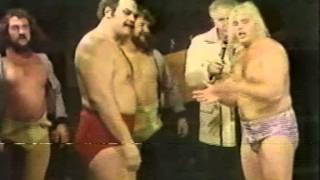
The second interview segment is from the end of the episode. Piper and Brooks, who just wrestled, join Wiskowski. Rowdy Roddy is sweating buckets and I regret we don’t have available footage from the match, which records show had Adrian Adonis and Ron Starr as the opposing duo. The schtick is heavy here. Rose brings a wheelbarrow to the elevated broadcast position to carry all the belts the quartet currently holds.

This is the oldest footage we have with Rose and Piper together in Portland. It’s striking that Piper, who has never been confused for a titan in the ring, has a good couple inches’ height advantage over Rose. Piper is only 24 years old here, and Rose leads him through the interview to some degree, circling him back a couple of times to hype his tag title match on the upcoming Tuesday. Rose also hands out a challenge for an eight-man elimination tag on next week’s program: Rose, Wiskowski, Piper, and Brooks (or “Brooksie” as Piper calls him, which is adorable) against “the four best Don Owen can find.”

4/7/79

We get a real treat here with the full elimination tag match set up on the prior episode. But first, an interview with the heels, who call themselves “the Fearsome Foursome.” They’re taking on Adonis, Starr, George Wells, and Hector Guerrero.

That wheelbarrow for the bad guys’ belts got a lot lighter in the past week. Adonis and Starr dethroned Piper and Brooks as tag champs the previous Tuesday, and have the belts. Meanwhile, Frank Bonnema mentions that Rose and Wiskowski lost their world titles the previous Monday night in Dallas. If you say so …

The match itself is a precursor to the elimination tags that the WWF made well-known with the Survivor Series pay-per-view. The first few Survivor Series consisted entirely of matches with this structure: multiple falls, and the loser of the fall has to go to the locker room. This isn’t the first match of its type in American wrestling history, but there’s a good chance it’s the oldest footage of a match of its kind. It’s certainly the oldest complete footage of a four on four elimination tag. We’re also treated to Adonis and Piper on opposite sides; they famously link up again about eight years later for Piper’s first retirement, at WrestleMania III.

The ensuing match lasts about 30 minutes, and it’s an “all killer, no filler” type of wrestling match. Having so many people involved and the ability to tag in and out means the eight wrestlers maintain a fast pace for the entirety.

Piper’s star shines brightly here, especially early. During introductions, he insists on playing his bagpipes — and Rose appeases the wrestling gods by clapping his hands and stomping his feet like he’s at a hootenanny and not a wrestling show in the Pacific Northwest. Piper starts out against Guerrero, who looks incredibly young, small, and thin here, but none of that matters when the bell rings, as Piper does a fabulous job throwing himself around the ring to make Hector look good. Once Piper does get in a little offense, he promptly whiffs on a dropkick to the delight of the Portland Sports Arena regulars. Guerrero and Wells take turns working on Piper’s arm. The actual holds don’t look like much but Piper’s facial expressions as he sells those holds? They’re everything.

Piper finally makes the tag to Rose, which leads to Wiskowski. Neither is in the match long but what ensues is an effective snapshot of what makes those two so effective in their role in the territory. They win most of their matches that really matter, few of which so far actually have made tape; those get saved more for the non-televised Tuesday shows in Portland. They’re vicious and use those tactics to put various opponents out of action. They’re also willing to lose more on TV than probably most headliners would in that era — definitely in this era — and they’re pretty generous overall in making themselves look foolish to delight the fans and get support behind their foes. There’s a great example of that here. Rose charges headlong into taking a series of bumps from Starr. Addled, he quickly tags out to Wiskowski, who trades strikes with Starr until the fan favorite gets the upper hand, sending Wiskowski sprawling with a blow that sends him flying backward and landing on his face. It’s an exaggerated sell that both defies the laws of physics and makes perfect sense in the context of the match, and Portland.

For all the schtick and the discombobulation on the heel side, Rose and company gain and keep the advantage throughout. Wells gets eliminated first, splashing Rose and going for the pin only to have Wiskowski deliver his diving headbutt — an established sure-fire finisher in the territory by now, leaving Wells easy prey to get pinned by the Playboy. Then Guerrero gets the gate after taking a series of double-team moves from Piper and Brooks, who show good continuity as a pair. The odds are against Adonis and Starr but the newly crowned tag champs come out full of fire in the third fall. After just a couple of minutes of action, Starr hits Brooks with a Russian legsweep. Wiskowski launches with another diving headbutt… why not? it worked in the first fall. This time, Wiskowski mistakenly hits Brooks, who gets pinned.

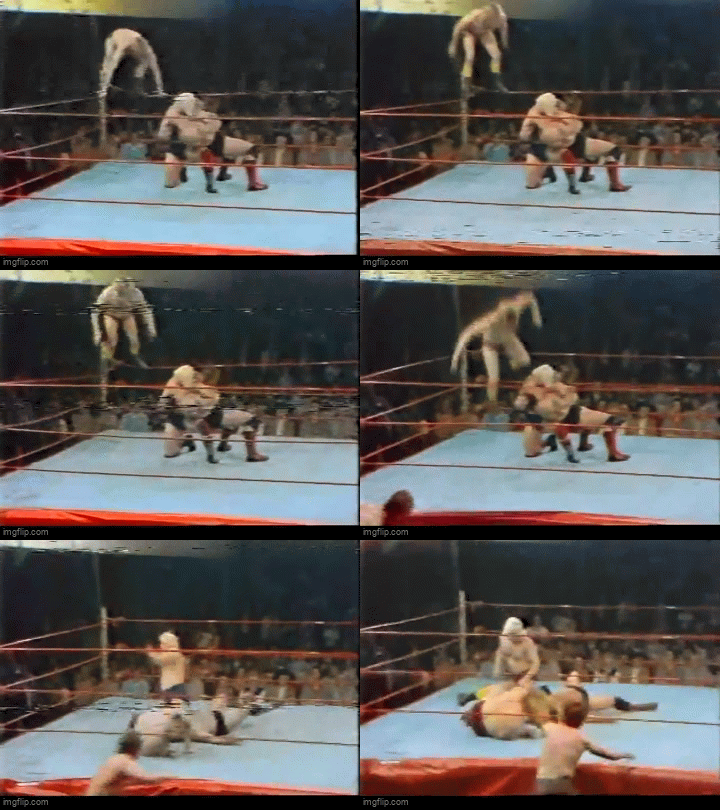
Piper and Brooks are none too pleased with that outcome, and the friendly collaboration between the two heel tag teams disintegrates. They start brawling with one another, and after Piper gets tossed to the floor, Rose and Wiskowski double team Brooks with a maneuver that looks like an ancestor to Demolition’s tag finisher:

You can see Piper re-entering the ring at the end of that gif, and his reaction upon seeing his partner waylayed is practically Shakespearean. Rose and Wiskowski, meanwhile, celebrate their deed in an interview with Bonnema between falls. “I broke his neck, I heard it snap!” is said with glee. As if they weren’t established enough as villains in the territory, Rose and Wiskowski refuse to go back out for any other falls — with Piper ostensibly tending to the injured Brooks, a fair two-on-two fight loses its luster.

Final word: This is a fantastic match and the best thing yet in this journey of watching Portland footage. Piper is fantastic, Rose is his usual highly entertaining self, and there’s historic value as well given it’s a complete four-on-four elimination tag from 1979. Take 40 minutes out of your day and watch it.

This is just the tip of the iceberg on the footage from 1979, so I’m excited to watch the feud between Piper and Rose develop.

Next Week: More from April of 1979. Until then, we’ll keep watching, From the Crow’s Nest.

Miss an entry? Check out the full index of Portland Wrestling reviews.

From the Crow’s Nest: December, 1977

From the Crow’s Nest: December, 1977

Back in the saddle with more Portland action. In this installment, we close the book on 1977 with this footage from December that also serves as a refresh of the roster.

I’ve included what is available on YouTube from the December, 1977 footage. However, if you want to make sure you’ve got access to everything I am watching as part of this project, I highly recommend supporting this Patreon account, which has a veritable treasure trove of old wrestling available.

December 3, 1977

Just a heads up that, depending on where you look online, footage from this episode is mis-listed as from November 26. Also, the video quality from this episode tends to range from “not great” to “piss poor.”

Frank Bonnema interviews returning fan favorite Johnny Eagles from England, dubbing Eagles as the man of a thousand moves. Eagles is one wrestler I have very little familiarity with, and while he came in and out of Portland with some regularity, there is not a lot of surviving footage of him in action — although he will be included on the next installment. Eagles brags on how strong the wrestling is in Portland, which is a recurring theme on commentary and in interviews with mainstays like Dutch Savage. A wrestling company that uses good wrestling as a cornerstone of its marketing approach … bananas!

The other existing footage from this episode catches the tail end of the main event: a two out of three falls match pitting Lonnie Mayne and Sam Oliver Bass (that’s Ron Bass, for those of you who haven’t been following along [and if not, there’s a handy dandy index!]) against Buddy Rose and Ed Wiskowski. The tag titles, which have been vacated since the last episode when Mayne agreed to team with Bass to defend them, are on the line and there are two referees: Savage inside the ring, and Sandy Barr at ringside.

This is also the final available Portland footage we have of Mayne, who dies the following August in a single-vehicle car accident. His manic, reckless-looking style is on display here, both in the ring and later on the mic. Wiskowski Irish whips Lonnie into a neutral corner, and Mayne takes a wild-looking bump to the floor, then comes up bloody. Back into the ring, and Wiskowski unloads on Mayne with a series of diving headbutts (I counted six of them). Rose and Wiskowski aren’t through and start swinging on everyone, including both referees. A melee ensues, during which Mayne opens up an absolute gusher of a cut on Rose. By the time the fight breaks up, Mayne and Bass (and Savage, for some reason) are standing tall while Rose looks like a murder victim.

Frank interviews both teams from his crow’s nest, and we get some of the best promos yet of this time period. Promoter Don Owen sets a rematch for the tag titles on Tuesday, and raises the stakes to make it losers leave town. Rose is absolutely covered in blood for this interview, and it really adds to the interview as Rose and Wiskowski rant and rave at this latest outrage perpetrated against them by management. Frank Bonnema then has an all-timer of a segue to the commercial between interviews, observing the blood that thoroughly coats the floor and then noting “You can clean up if you’re looking for a used car.”

Mayne and Bass are next, and Maybe spends the whole interview chewing on and swallowing broken glass. We’ve seen other wrestlers do this and apparently it’s an established part of Mayne’s schtick because it’s treated with a sense of impending doom, as if to say … “Lonnie’s not screwing around, he’s got the glass out again!”

Mayne and Bass go on to lose the non-televised rematch and cycle out of the territory.

There’s not much meat here as far as the wrestling action, but the blood and chaos and good interviews make for a highly enjoyable watch.

December 10, 1977

All we have from this episode is the second and third falls of the main event. Rose and Wiskowski, tag champs once more, take on Skip Young and Jimmy Snuka in a non-title match. Snuka is another guy who came into Portland several times in the 1970s and, as mentioned on a previous episode, now is going by his “Superfly” moniker. A review of results from 1977 show that Snuka has been in the territory for almost a month on this current run, but this is the first in-ring footage we have.

Snuka spends most of this on the apron while Skip does the bulk of the work and the selling for Rose and Wiskowski. When Snuka does tag in, the heels make him look like a million bucks. Wiskowski takes some big bumps from Snuka when he makes the tag in the second fall, which ends shortly thereafter to tie the match on a slick quick pin by Skip. In the third fall, another hot tag to Snuka sees him put away Rose in fairly short order with the “Fiji Island Full Nelson.”

Rose’s selling is consistently great but he sells beautifully in this match and the following interview. He projects an air of grievance that permeates his words, facial expressions, and physical reactions. It’s as if the world is against him in Portland wrestling, and Rose has to suffer for it almost weekly as a result. A couple of moments I particularly liked… A brief beat between falls where, on his way to the locker room, Snuka pops Rose as he leaves the ringside area and Rose sells it as if he’s just been seared in the face with a hot iron. Then after the match, an anguished Rose seeks out comfort from Wiskowski. Sporting a large bandage on his forehead that is likely the consequence of his artery tapper last week, Rose proclaims “They’d have had to kill me to make me give up” had the titles been on the line. The heels then engage in some casual racism — mostly from Wiskowski, sheesh — before a title match gets set for next week’s TV program. Sadly, footage of that one appears lost to the sands of time.

So 1977 is in the books, and there’s little debate that Buddy Rose is the MVP of the territory. If you are not familiar with Rose, I highly recommend seeking out some of the footage in this and prior installments to get a feel for his matches, his persona and the general atmosphere of Portland wrestling.

Up Next: We tackle what little footage that exists from 1978 in one single review.

Miss an entry? Check out the full list of From the Crow’s Nest series on our Portland Wrestling page.

From the Crow’s Nest: Introduction, and a 1977 Exposition

From the Crow’s Nest: Introduction, and a 1977 Exposition

Welcome to From the Crow’s Nest! This will be an ongoing series of reviews looking at the history of wrestling in Portland, Oregon … specifically Pacific Northwest Wrestling.

The history of Portland Wrestling goes as far back as 1925 (we won’t go that far back), but it’s best known for the multiple decade run under Don Owen, whose father, Herb, founded the promotion.

The Portland territory was unique, in a few ways.

  1. It was small. Owen usually kept an active roster of just 10 to 12 wrestlers, and worked a busy loop of shows in Oregon, Washington, and British Columbia in Canada. You’ll see this on some of the TV segments where they break down the upcoming calendar.
  2. Because of the small roster, episodes of Portland’s TV program had a structure that was unique but also seems a perfect fit for a television show. The main event of most episodes was best two out of three falls. Between falls, wrestlers typically went back to the locker room, and during these brief intermissions, they would either hold interviews with wrestlers or cut to commercials with sponsors. It’s a hoot watching the latter, and seeing both the style of the time and some of the prices that seem insanely low, especially by 2025 standards.
  3. Portland’s TV program was an institution in the region. Owen ran his TV every Saturday night out of the Portland Sports Arena — a renovated bowling alley that the promotion owned. Eddie Graham followed a similar tact in Florida, running his promotion out of a building he owned. The show aired live — and then, live to tape — on KPTV Channel 12 in Portland for decades, on nothing more than a handshake deal.
  4. The crowds, at least on these initial episodes, were red hot. Owen offered “season passes” to the TV tapings, which, combined with the regular loop of towns, forced his wrestlers to shake up their routine and not work the same kind of match time after time. “The first several rows of ringside, you couldn’t buy a ticket, because they were all permanent reservations,” Dave Meltzer once said about Portland crowds to Slam Wrestling. “The first six rows had the same people sit in those chairs for 52 weeks a year for years on end. The only way to get a ringside ticket was if one of them died, you literally had to be in their will.”
  5. The Portland product is, in some ways, a harbinger of what changed in wrestling in the 2000s. The promotion emphasized more smaller wrestlers and a fast-paced style. Owen also had a reputation for paying well, which left no shortage of individuals who wanted to make their way through the territory. Consequently, a who’s who of talent makes appearances in Portland over the years.

With that introduction out of the way, let’s dive right into the footage.

We pick up with what I believe is the oldest existing video from Portland’s TV show.

Lonnie Mayne vs. Jesse Ventura, 5/7/77

You may know the Moondogs more as the tag team that worked throughout different territories in the U.S., but Mayne was actually the original Moondog. He also would have a much larger legacy in wrestling if he hadn’t been lost too soon. He died in 1978 at the age of just 33 in a car accident en route to a booking in California. Mayne worked almost exclusively as a heel in the early 1970s, and challenged Pedro Morales for the WWWF Title at Madison Square Garden. By 1977, though, Mayne was a beloved fan favorite of the Portland Sports Arena crowd. There’s an excellent bio of Mayne at Pro Wrestling Stories if you’d like to know more about him.

In this match, a best-two-out-of-three fall affair as was the custom on Portland TV, Mayne wrestles Ventura, who was at this point a fixture in the territory before going on to bigger stages in the AWA and WWF. The surviving footage starts with the first fall in progress, then jumps ahead to the third fall, with no finish. Mayne had a reputation for being wild in and out of the ring; at one point, he heads to ringside and throws a drink in Ventura’s face. One punch later and Ventura goes sprawling to the floor.

Between the ropes, Mayne was rather fearless. In the third fall, he takes a variation of what I know best as the Harley Race bump to the floor: hooking his feet on the ropes then dropping down on his head. As if the beverage wasn’t enough, Jimmy Snuka — another wrestler who became a regular in Portland in the 1970s before moving to bigger stages — comes to ringside and tosses Mayne a cowbell to start laying waste to Ventura. Somehow, this isn’t a DQ.

This one falls in the Worth Watching category for me. There’s nothing earth-shattering here but the crowd is hot, the action is entertaining, and there’s some significant historic value here.

Cocoa Samoa vs. Buddy Rose , 8/13/77

This is the earliest footage in Portland of Buddy Rose. If there’s an all-time MVP of the territory, it’s probably him. I also think Rose is one of the most underrated wrestlers of all time and, if you follow me through this journey, don’t be surprised if you end up agreeing. Rose can chain wrestle, brawl, and fly. He takes these fantastic heedless-looking bumps, and gives enteraining interviews as a villain who is either talking trash or extremely aggrieved at some perceived injustice. Meanwhile, he has a willingness to bleed buckets that I found endearing. This match with Cocoa is just the tip of the iceberg on the footage of Rose, who personally is responsible for most of the surviving footage from Portland in this era, because he had a habit of recording episodes of Portland’s TV program so he could go back and review his matches.

The video quality is not the best and Portland commentator Frank Bonnema — whose broadcast position is referred to as The Crow’s Nest (get it?) — pooh-poohs what he perceives as a light crowd. Adding greatly to the atmosphere, there’s a granny in the front row who’s vigilant as Rose repeatedly pulls on Cocoa’s trunks while ensnared in a headlock. At one point in the match, Cocoa delivers his leaping headbutt and Rose takes what I consider his signature bump: an explosion of movement where he pushes off with his legs and sends himself flying back to the mat. The landing is more reminiscent of a cartoon character who slipped on a banana peel. It’s ridiculous taken as a snapshot, but it works because it’s so over the top. It’s a regular part of Rose’s matches and it often serves the purpose of making the opposing wrestler’s offense look devastating, which, really, is one of the major points of a wrestling match, isn’t it? Rose wins the match clean with a modified backbreaker that looks like something out of the Roderick Strong arsenal, but the decision gets overturned when he keeps attacking Cocoa, ultimately shoving referee Sandy Barr.

This is honestly Skippable, but if you’ve never seen Buddy Rose in action, it’s a fine introduction with a low investment of time.

Up Next: We continue the journey in 1977.

365 Wrestling, Day 5: 8 Man Tag (Pacific Northwest Wrestling, 1/5/80)

365 Wrestling, Day 5: 8 Man Tag (Pacific Northwest Wrestling, 1/5/80)

365 match reviews, one for each date on the yearly calendar? Challenge accepted. Welcome to 365 Wrestling.

Do you enjoy watching good wrestling? Are you a wrestler looking to improve? If you can answer yes to either question, then I have one piece of advice: watch more Buddy Rose.

Today, we’re taking a look at a two out of three falls tag match from Portland in January 5, 1980 featuring Rose — Pacific Northwest Wrestling’s top heel at the time — teaming with the Kiwi Sheepherders, Butch Miller and Luke Williams (you may know them better as the Bushwhackers), and Sam Oliver Bass (better known as Outlaw Ron Bass). Their opponents are the quartet of Roddy Piper, Rick Martel, Dutch Savage, and Stan Stasiak. You can find this match on YouTube, or embedded below:

Part 1
Part 2

The Match

Portland weekly TV at the time was structured around long matches, many of them two out of three falls with sponsor plugs and interviews between falls. This match follows that formula. It’s also the latest chapter in a feud between Rose and Piper that began the prior spring. Rose has recruited Bass and the Sheepherders to his “Army.” The shenanigans between Rose and Piper in 1979 included Rose, in an act of sublime dastardly heeldom, setting fire to Piper’s kilt from the Crow’s Nest broadcasters’ position while the Rowdy Scot was part of a tag match. Fun fact, PNW pre-taped its TV show at the time, but fans watching thought it was happening live and called the fire department.

Piper’s team consists of Martel, who is new on the scene in Portland; Savage, a mainstay in PNW and one of the promoters of the territory; and Stasiak, best known for his “heart punch” and being the man who dropped the WWF Title to Bruno Sammartino to begin Bruno’s second reign as champion. By this point, Stasiak is in the twilight of his career.

The booking here accomplishes three goals, which is an impressive juggling act. First, building Martel for an imminent shot at Harley Race and the NWA Worlds Heavyweight Title. Second, to advance the feud between Piper and Rose. Third, to establish Rose’s Army as a force.

Most of the action is basic pro wrestling you’ve seen a thousand times, but it’s all done well and the crowd is red-hot for the first fall, which lasts more than 20 minutes. Rose is involved on the three big highlights of the match: a rapidly-paced exchange with Piper in the opening minutes, taking a Martel Irish whip into the opposite corner where he throws himself headlong above the turnbuckles to smash into a long pole extending from the ringpost, and then, in the second fall, feeding into a late hot tag by Martel, who busts out a huracanrana (in 1980!!!) as part of his comeback.

Rose sells for everybody in this one, whether it be an exaggerated bump on the apron after Savage punches him, or reacting to Stasiak’s “reverse pumphandle armbar”, as Frank Bonnema calls it, like he’s being interrogated in a medieval torture device. This match loses quite a bit of steam heading into the second fall and the intensity continues to diminish — the opposite of what you want — with the minute-by-minute calls of ring announcer Don Owen (the promoter of the territory), making a time-limit draw finish as obvious as a flashing neon sign.

Final Rating: 6.0

This one is definitely worth seeking out to watch. You get a good look at a highly-energized Piper, the Sheepherders with a distinctly different look, and Bass in his prime. The star, though, is Rose. Rose shines in the style of the Portland territory, thanks to his combination of tremendous promos, meticulous mannerisms in the ring, and bumping heedlessly to make his opponents look like a million bucks. I assure you, this won’t be the only time you see Rose on this list.

What’s Next

Two of the top female wrestlers of the 2000s battle in a No DQ brouhaha.

Here’s the complete, ongoing list of matches in this project.

Follow In Moorehouse Wrestling on FacebookTwitter and Instagram!