From the Crow’s Nest: October, 1977

From the Crow’s Nest: October, 1977

Welcome to the second installment of From the Crow’s Nest, a series of articles looking back at Pacific Northwest Wrestling and the history of wrestling in Portland, Oregon.

In this week’s installment, we cover available footage from October of 1977. It’s a pretty good haul for this month, with at least some footage from three out of four episodes in the month from the Saturday night Portland TV show. Most of the footage is on YouTube and is embedded at the end of this article. The video quality on some of this is pretty poor, but the action holds up.

October 1, 1977

Gino Hernandez vs. John Anson

We pick up in the early stages of a match between Anson, who is one half of the tag champs with Sam Oliver Bass (you know him better as Outlaw Ron Bass), and a very young Gino. This is, to my knowledge, the earliest existing footage of Hernandez and seeing him as a plucky young babyface is quite the change of pace considering he’s best known from his years as an arrogant heel for various promotions in Texas.

Like the two out of three falls match between Buddy Rose and Jay Youngblood, a good bit of this match is based around the headlock — only there’s far less sizzle as this encounter lacks both the crowd engagement or the type of selling Rose does in the hold. I wouldn’t call this a good match, but it’s decent and gets significant time. It feels like desperation when Anson starts throwing headbutts, and at one point the two start trading fatigued punches from their knees. Gino comes close to scoring the win a few times, reminiscent of a modern-day New Japan match with a young lion going against a wrestler on the main roster. Hernandez and Anson go the distance, and in the aftermath, commentator Frank Bonnema waxes on how much wrestling in the territory has improved in the past decade.

2/3 Falls: Lonnie Mayne vs. Buddy Rose

This is, in my opinion, the first great match in this project. What makes it great? It encapsulates the entire style of the promotion, and, to a greater extent, wrestling in the 1970s. It’s gritty, brutal, and bloody. It also matches up the territory’s biggest fan favorite in Mayne against Rose, unquestionably the most hated man in Portland.

There’s a story here, and you don’t need to have a literature degree to understand it. Rose has kept hurting other wrestlers in the territory. Mayne, who was friends with many of those injured, wants revenge.

Mayne and Rose get right down to business, with Rose trying for a cheap shot while still wearing his entrance robe. Mayne cuts him off and Rose pays the price. Mere seconds later, Mayne launches off the top with a nasty-looking flying knee drop that catches Rose square in the stomach for the pin to end the first fall. Rose doubles over and vomits in the ring after the fact — which is either proof that knee was very snug or a supreme moment of selling by Rose to be able to vomit on cue. I don’t know which is true, and I actually enjoy the uncertainty.

The little touches elevate what happens between the ropes. In the introduction to this series, I wrote about the unique setting of the Portland Sports Arena, with many fans who come out every week for the TV shows. This creates a level of investment from the crowd that is hard to replicate and even harder to truly explain unless you see it for yourself. After the first fall, Mayne picks up some little girl on his way back to the locker room and no one bats an eye at it. Heading into the second fall, one of the several old ladies who sit in the front row starts chasing Rose around the ring with her cane. Then Mayne takes her cane and tries to use it on Rose. After Rose takes the second fall, bloodying Mayne in the process, fans flock to Mayne as he sits slumped in the corner waiting the third fall; encouraging pats on the back ensue and someone even offers Mayne their drink.

By now, blood (and vomit) have been spilled, creating a heat and hatred for the third fall that feels visceral. A mistake by Rose leads Mayne to attack his arm, looking to make good on last week’s vow to break the arm of the Playboy. Mayne is so relentless that he shoves and then punches referee Sandy Barr when he attempts to intercede, getting himself disqualified. The attack continues around the ringside area until Rose retreats to Bonnema’s crow’s nest broadcast position. I enjoyed this quite a bit, while the main purpose is to serve a street fight rematch between the two a few days later that, sadly, was not televised.

October 8, 1977

Buddy Rose vs. Cocoa Samoa

This is a rematch from their TV bout back in August. Rose does his best Gorgeous George impression in the pre-match, meticulously folding his T-shirt as part of an extended stall. Cocoa ensnares Rose in a headlock and wrenches on it, like Youngblood did last month. Once again, the way Rose sells this is everything. When Cocoa takes down Rose, the Playboy tries to reverse into a pin with a handful of tights but the granny at ringside is on the case, hollering at the referee. Rose attacks the arm of yet another opponent and hooks what looks like a modified kimura to get the submission. Neat.

Mayne is set to wrestle Ed Wiskowski, Rose’s partner, in the main event but that match is absent from the surviving footage. What we do get is a 10-man battle royal for $1,000. Considering that promoter Don Owen tended to maintain a tight crew, this is probably the entire active roster in Portland at that time. The highly invested crowd makes this a fun watch and Gino Hernandez gets a chance to shine as one of the final wrestlers left standing — and takes a pretty spectacular plummet to the concrete floor on his elimination.

October 22, 1977

Dutch Savage, Lonnie Mayne & Skip Young vs. Buddy Rose, Ed Wiskowski & Sam Oliver Bass

Frank Bonnema sets the scene, mentioning some issues between Bass and Rose when they teamed together at a recent event. The theme of dissension is established and plays out in what looks more like a comedic farce on stage than a wrestling match at times. Rose and Wiskowski leave Bass hanging to start the match and, on two occasions in the first fall, Bass gets drilled by mistake by one of his partners. Later, when Savage is working over Bass’ left arm, Rose and Wiskowski deliberately pull back as Bass reaches for the tag. The crowd hoots, hollers, and applauds with delight at each of these moments, and Bass’ facial expressions and body language project his increasing sense of frustration and fury. Despite all the issues within their team, the rulebreakers score the first fall when Wiskowski catches Skip Young with his diving headbutt, a strongly established finishing move in the territory.

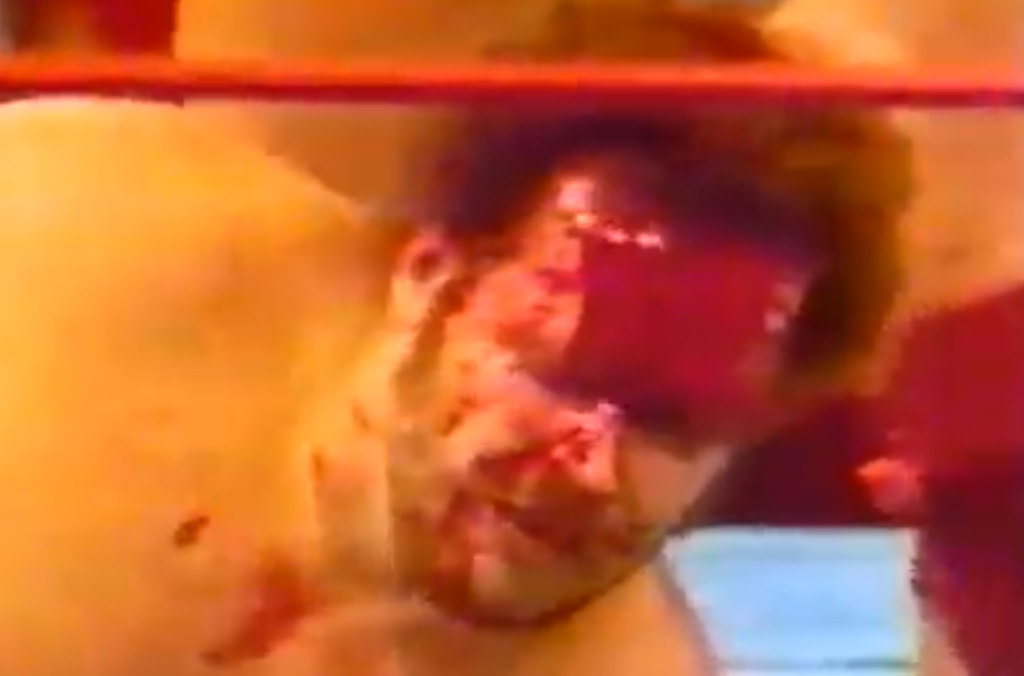
After the usual round of live-to-tape commercials between falls (buy a Pinto for $1,000!), we’re back and the dissension between Bass and Rose and Wiskowski continues. Another miscue — this time Rose accidentally dropkicking Bass — leaves him prey to get pinned by Skip and even the match at one fall apiece. The heel team falls apart, with Rose and Wiskowski assaulting Bass. What had, to that point, been played often for laughs turns deadly serious as Bass gets turned into a bloody mess.

Make that a very bloody mess.

It’s an effective beatdown, showing there’s no honor among thieves for the heels in Portland — or, at least, when it comes to Rose and Wiskowski. The break between falls really gives this attack time to breathe. Bonnema interviews Mayne, whose disgust at what happened to Bass adds extra zest to a delicious bit of business. I also greatly enjoyed the little touch by Rose before the third fall, smearing Bass’ blood into the mat with his boots. The third fall is reduced to a straight two on two tag, with Savage and Skip the opposition, and time expires fairly quickly in the fall. That’s all precursor to the post match, when Rose and Wiskowski go to the crow’s nest for an interview and a blood-soaked, bandaged Bass attacks! The crowd is molten hot for this as Bass slams Rose on the wooden commentary desk. Bass is out for blood and vengeance and demands a match with Rose on next week’s episode. The footage of that is unavailable, but it makes you want to tune in next week regardless, and isn’t that the point of any wrestling show — or TV show, period?

Somewhat lost in the shuffle of this blood-soaked tale of dissension: this is the debut in the Portland footage of Skip Young. When you think about wrestlers from prior decades who would have succeeded in the current era, Young definitely classifies. I could see him being a great fit for any modern promotion. He gets a few months to shine here: most notably, in the short second fall, when he busts out an impressive high leapfrog, then a sweet standing dropkick, and kips up ready to keep bringing the fight. Unfortunately, there’s not a lot of Skip Young in this territory, but some enjoyable matches lie ahead nonetheless…

From the Crow’s Nest: September, 1977

From the Crow’s Nest: September, 1977

Welcome to the second installment of From the Crow’s Nest, a series of articles looking back at Pacific Northwest Wrestling and the history of wrestling in Portland, Oregon.

In this week’s installment, we will cover available footage from September of 1977. Most of it’s on YouTube and is embedded at the end of this article.

2/3 Falls,: Jay Youngblood vs. Buddy Rose, 9/10/77

The September footage is anchored by two matches between Rose, a Portland mainstay, and Youngblood. Jay is best known for his time in Mid-Atlantic Championship Wrestling — especially teaming with Ricky Steamboat in The Final Conflict cage match that’s widely considered the predecessor to Starrcade. He’s still in the fairly early stages of his career here.

Both Rose and Youngblood are entertaining in the ring, and this matchup doesn’t disappoint. However, the special referee that’s “assigned” adds an extra level of enjoyment. That referee is Lord Jonathan Boyd, another Portland fixture. Boyd was in and out of the territory throughout the 1970s, primarily as a heel and often teaming with Norman Frederick Charles III in The Royal Kangaroos, a team that borrowed its gimmick and base name from The Fabulous Kangaroos, maybe the first great tag team in wrestling. Boyd also was part of an iteration of The Sheepherders, who begat The Bushwhackers in WWF.

But I digress … Boyd is a fan favorite in Portland by 1977, and when he’s revealed as the referee, the crowd loves it while Rose throws a fit.

We’ve all seen matches with a special referee, but the lengths to which Boyd goes to chew the scenery — and officiate being entirely one-sided for Youngblood — truly go the extra mile. Every count that Boyd makes on Rose, be it for a pin or being outside the ring or even in the ropes, is rapid fire. Later, when Rose grabs a handful of Youngblood’s trunks, Boyd twists Playboy Buddy’s thumb to break the hold. The capacity crowd in the Portland Sports Arena cheers and laughs along throughout, creating the atmosphere more akin to a theater audience watching a farce on stage than a wrestling match. The fans are also red hot in their support of Youngblood, and their hatred for Rose. A “We Want Jay!” chant bellows through the building on a few occasions over the three falls.

There are certain sports and sequences that were pretty standard in wrestling years ago that have fallen by the wayside in 2025. The criss-cross is one of them, and Rose and Youngblood bust out a high-speed version of it here. Rose busts out a couple of nice leapfrogs during this, showing the athleticism that a lot of people might overlook from his frame and physique. Jay ensnares Rose in a sunset flip and scores the pin on a three count Boyd makes in less time than it took me to type these words (and I’m a fast typer).

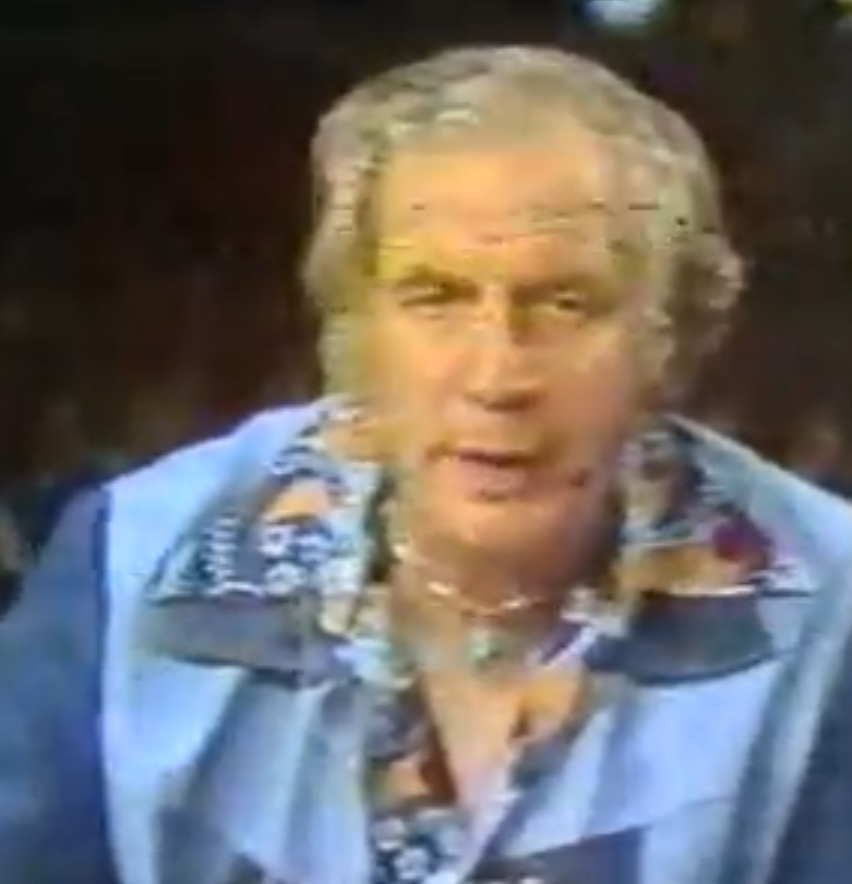
Now we go to the content between falls, which is part of the retro charm of these episodes. It starts with commentator Frank Bonnema, whose outfit tonight is an epic example of late 1970s fashion.

Other highlights that a modern viewer might find fascinating:

  • A plug to get tickets to the next taping of Portland TV, either at the concession market or visiting the flea market stand run by Sandy Barr, a referee for the promotion. And today people wait in angst in a TicketMaster queue …
  • The sponsors then take their turn. On many Portland episodes, these were live-to-tape commercials, and we get one of those here from Friendly Chevrolet. Granted this was almost 50 years ago, but the prices are mind-boggling in this era of soaring costs. $5295 for a truck! $5695 for a truck with four-wheel drive and a V8 engine! A 77 El Camino for $5595!
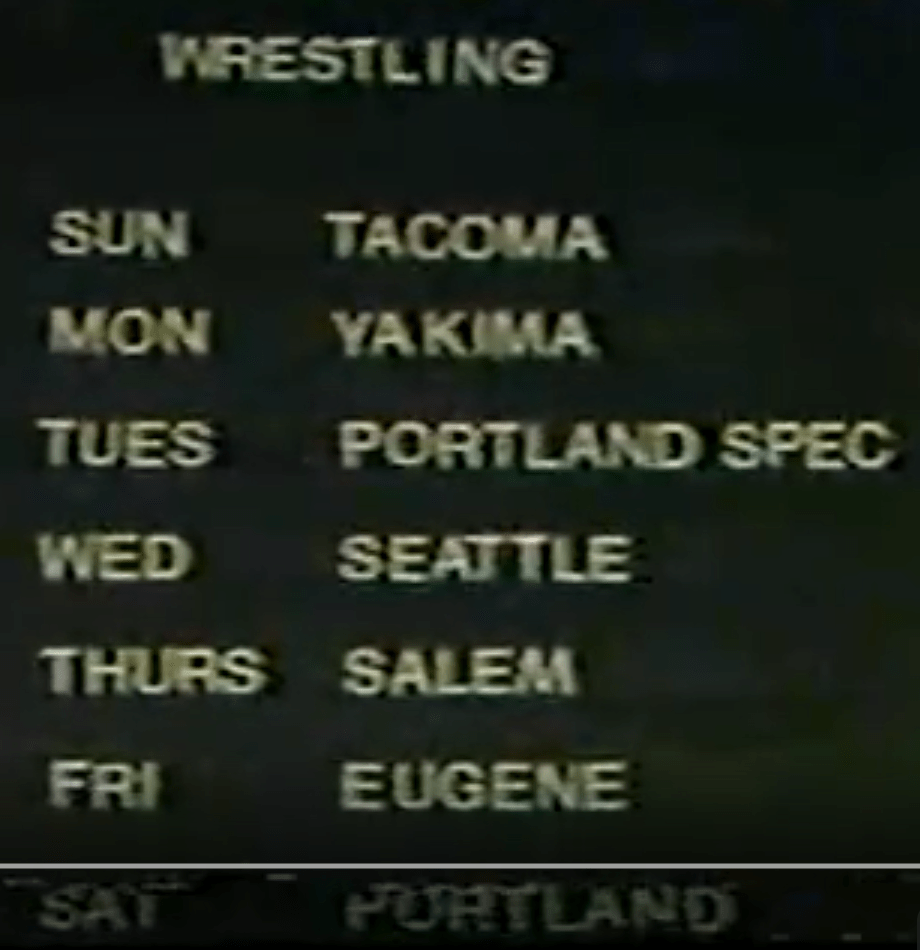
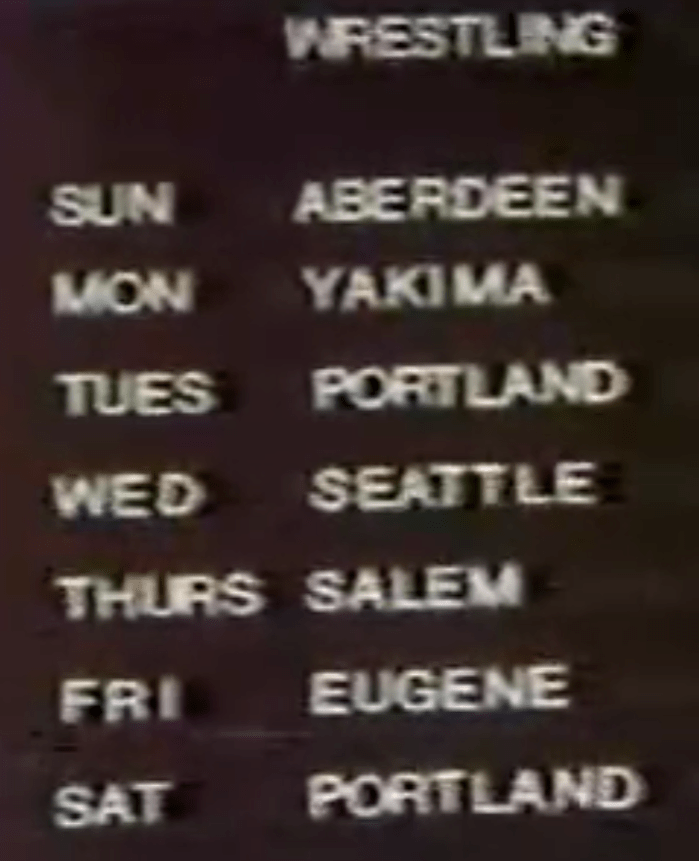
  • Bonnema also shares the schedule for the next week of shows in the Pacific Northwest… and there literally are no days off.
  • We also get a delightful interview with fan favorites Lonnie Mayne and Dutch Savage (the latter was also a longtime booker for the promotion) where Bonnema reads a letter presumably from a 91-year-old widow who wants to help Mayne run out all the rulebreakers from the territory. Adorable.
A sample week of shows in Pacific Northwest Wrestling in September of 1977. Wrestlers, especially those still learning the business, sought out that territory for the busy schedule and better paydays.

Around all the schtick with Boyd, Youngblood and Rose work the bulk of this match around the side headlock, usually with Youngblood ensnaring Rose. The crowd is so loud and engaged that they buy right in when Jay goes right back to the headlock and he starts wrenching on the hold, as the crowd counts along! Rose, meanwhile, is paying homage to the Wrestling Gods with the way he sells the hold, slumped against Jay and hanging lifeless like a limp dishrag.

In the first fall, Rose shot Youngblood off into the ropes to counter the headlock and initiate the criss-cross that led to the pin. Rose tries again, but learns from his mistakes and counters with a fine-looking backdrop on Youngblood. Bonnema, who does a quality job as a TV host and brings a late-night DJ vibe to his commentary, calls this a “shoulder throw”, for reference.

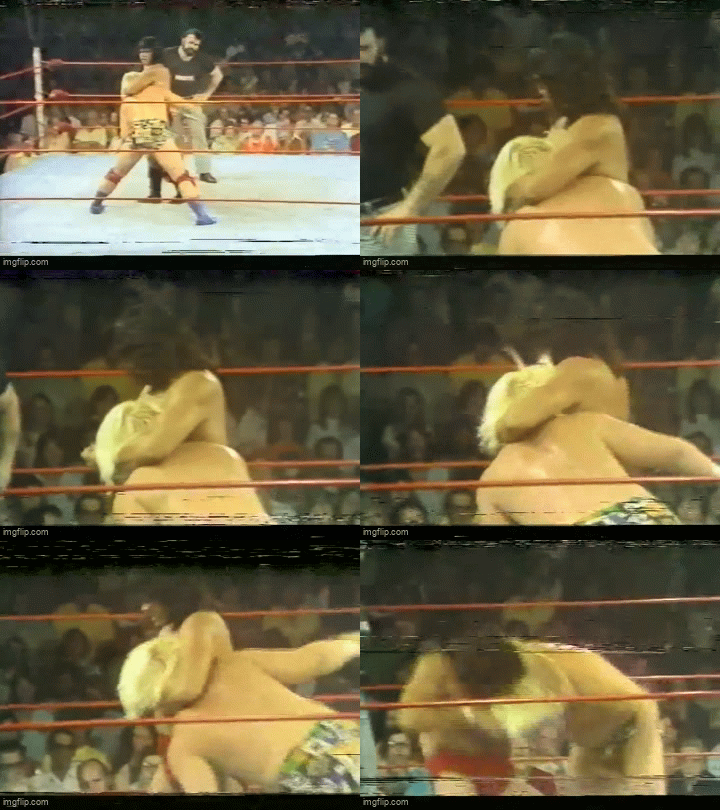
Rose focuses in on the back, then finishes Youngblood using the same back suplex into a backbreaker that he used to beat Cocoa Samoa in the first installment of our series of articles. For the record, it still looks like something from the Roderick Strong arsenal of moves. Boyd is still in full schtick, making a very deliberate and slow three count. Rose demands his hand be raised, and Boyd ignores it … but he does make sure to stomp on Rose’s hand when the Playboy starts pounding the mat in frustration.

Another between-fall break with commercials and live-to-tape advertising, which includes a razor commercial that must be seen to be believed. There’s also some footage of Jimmy Snuka, who’s promoted as making appearances in the territory that coming week and shows up in surviving footage from the end of the year. The best part of these clips for me is that legendary wrestler Danny McShain is the referee for one of the matches.

Before the third fall begins, Bonnema interviews John Anson and Sam Oliver Bass (you probably know him better as Ron Bass), the current tag champs in the territory. Bass and Anson are set for a death match tag that same night that won’t make TV, and Bonnema urges fans to check their newspaper for the results. Weird, wild, and very different times …

The third fall is joined in progress and time is running out on the show. Rose takes control but every pin attempt is met by another glacial count by Boyd. The Playboy snaps and starts stomping Boyd, who comes up swinging off the mat to the unfiltered delight of the crowd. The opening salvo of blows ends with Rose getting sent flying in that style of bump I wrote about in the first installment of the series. The blood starts to flow from Rose’s head and Boyd continues to hammer him as the footage ends.

This is a Very Good match that you should go out of your way to watch. The final two falls are available on YouTube, but definitely track down the first, which also is available online if you know where to look, because of all the antics with Boyd’s biased officiating serving as a method to torment Rose. Yes, the third fall is rushed, but it also shows how Rose had just reached his tipping point. All told, the match weaves a compelling and entertaining story with several well-executed bits of humor. You just don’t see wrestling like it today.

Jay Youngblood vs. Buddy Rose, 9/24/77

This match is on the undercard of this TV broadcast, so it’s just one fall and what ensues is more of an angle than a match. To be fair, it’s a good angle, as Rose and his running buddy Ed Wiskowski injure Youngblood’s left arm. This is just the latest victim for Rose; on commentary early in this footage, Bonnema refers to Boyd getting taken out of the territory by the Playboy. There’s a nice bit of misdirection as the match begins with Rose distracting Sandy Barr while Wiskowski, who is seconding Rose, grabs Youngblood’s leg and wrenches it from the floor. Rose focuses a relentless assault on Youngblood’s left arm, to the point Mayne runs in for the save and removes his own boot to club at Rose. Sandy Barr eats shit to the floor during the chaos and, in one of my favorite bits of this, ringside fans go to help him up.

Jay really sells the attack and injury. He’s got a cut dripping down the injured left arm and is alternating between writhing in pain and screaming. The camera stays right with the scene and that hot capacity crowd in the Portland Sports Arena watches in a hush. Mayne and Jay’s older brother, Rick Youngblood, are out to help Jay to the back and he collapses while they’re in transit. Fantastic.

After another car commercial (all the vehicles for sale have AM radio, you guys!) Bonnema interviews Mayne from the Crow’s Nest. Moondog Lonnie vows vengeance and that he’ll break Rose’s arm next week the way Rose has done to so many. Mayne is wild and fiery here. He also lived hard; he’s 33 here and this footage is filmed less than a year before his death, but he looks 50. Given what I’ve read about Mayne’s life, when he drops his “There’s excitement in the air!” phrase, I can’t help but wonder if the excitement and whiskey have the same aroma.

As for the Mayne vs. Rose match? It will kick off the next article.

Check out the introduction to this series.

From the Crow’s Nest: Introduction, and a 1977 Exposition

From the Crow’s Nest: Introduction, and a 1977 Exposition

Welcome to From the Crow’s Nest! This will be an ongoing series of reviews looking at the history of wrestling in Portland, Oregon … specifically Pacific Northwest Wrestling.

The history of Portland Wrestling goes as far back as 1925 (we won’t go that far back), but it’s best known for the multiple decade run under Don Owen, whose father, Herb, founded the promotion.

The Portland territory was unique, in a few ways.

  1. It was small. Owen usually kept an active roster of just 10 to 12 wrestlers, and worked a busy loop of shows in Oregon, Washington, and British Columbia in Canada. You’ll see this on some of the TV segments where they break down the upcoming calendar.
  2. Because of the small roster, episodes of Portland’s TV program had a structure that was unique but also seems a perfect fit for a television show. The main event of most episodes was best two out of three falls. Between falls, wrestlers typically went back to the locker room, and during these brief intermissions, they would either hold interviews with wrestlers or cut to commercials with sponsors. It’s a hoot watching the latter, and seeing both the style of the time and some of the prices that seem insanely low, especially by 2025 standards.
  3. Portland’s TV program was an institution in the region. Owen ran his TV every Saturday night out of the Portland Sports Arena — a renovated bowling alley that the promotion owned. Eddie Graham followed a similar tact in Florida, running his promotion out of a building he owned. The show aired live — and then, live to tape — on KPTV Channel 12 in Portland for decades, on nothing more than a handshake deal.
  4. The crowds, at least on these initial episodes, were red hot. Owen offered “season passes” to the TV tapings, which, combined with the regular loop of towns, forced his wrestlers to shake up their routine and not work the same kind of match time after time. “The first several rows of ringside, you couldn’t buy a ticket, because they were all permanent reservations,” Dave Meltzer once said about Portland crowds to Slam Wrestling. “The first six rows had the same people sit in those chairs for 52 weeks a year for years on end. The only way to get a ringside ticket was if one of them died, you literally had to be in their will.”
  5. The Portland product is, in some ways, a harbinger of what changed in wrestling in the 2000s. The promotion emphasized more smaller wrestlers and a fast-paced style. Owen also had a reputation for paying well, which left no shortage of individuals who wanted to make their way through the territory. Consequently, a who’s who of talent makes appearances in Portland over the years.

With that introduction out of the way, let’s dive right into the footage.

We pick up with what I believe is the oldest existing video from Portland’s TV show.

Lonnie Mayne vs. Jesse Ventura, 5/7/77

You may know the Moondogs more as the tag team that worked throughout different territories in the U.S., but Mayne was actually the original Moondog. He also would have a much larger legacy in wrestling if he hadn’t been lost too soon. He died in 1978 at the age of just 33 in a car accident en route to a booking in California. Mayne worked almost exclusively as a heel in the early 1970s, and challenged Pedro Morales for the WWWF Title at Madison Square Garden. By 1977, though, Mayne was a beloved fan favorite of the Portland Sports Arena crowd. There’s an excellent bio of Mayne at Pro Wrestling Stories if you’d like to know more about him.

In this match, a best-two-out-of-three fall affair as was the custom on Portland TV, Mayne wrestles Ventura, who was at this point a fixture in the territory before going on to bigger stages in the AWA and WWF. The surviving footage starts with the first fall in progress, then jumps ahead to the third fall, with no finish. Mayne had a reputation for being wild in and out of the ring; at one point, he heads to ringside and throws a drink in Ventura’s face. One punch later and Ventura goes sprawling to the floor.

Between the ropes, Mayne was rather fearless. In the third fall, he takes a variation of what I know best as the Harley Race bump to the floor: hooking his feet on the ropes then dropping down on his head. As if the beverage wasn’t enough, Jimmy Snuka — another wrestler who became a regular in Portland in the 1970s before moving to bigger stages — comes to ringside and tosses Mayne a cowbell to start laying waste to Ventura. Somehow, this isn’t a DQ.

This one falls in the Worth Watching category for me. There’s nothing earth-shattering here but the crowd is hot, the action is entertaining, and there’s some significant historic value here.

Cocoa Samoa vs. Buddy Rose , 8/13/77

This is the earliest footage in Portland of Buddy Rose. If there’s an all-time MVP of the territory, it’s probably him. I also think Rose is one of the most underrated wrestlers of all time and, if you follow me through this journey, don’t be surprised if you end up agreeing. Rose can chain wrestle, brawl, and fly. He takes these fantastic heedless-looking bumps, and gives enteraining interviews as a villain who is either talking trash or extremely aggrieved at some perceived injustice. Meanwhile, he has a willingness to bleed buckets that I found endearing. This match with Cocoa is just the tip of the iceberg on the footage of Rose, who personally is responsible for most of the surviving footage from Portland in this era, because he had a habit of recording episodes of Portland’s TV program so he could go back and review his matches.

The video quality is not the best and Portland commentator Frank Bonnema — whose broadcast position is referred to as The Crow’s Nest (get it?) — pooh-poohs what he perceives as a light crowd. Adding greatly to the atmosphere, there’s a granny in the front row who’s vigilant as Rose repeatedly pulls on Cocoa’s trunks while ensnared in a headlock. At one point in the match, Cocoa delivers his leaping headbutt and Rose takes what I consider his signature bump: an explosion of movement where he pushes off with his legs and sends himself flying back to the mat. The landing is more reminiscent of a cartoon character who slipped on a banana peel. It’s ridiculous taken as a snapshot, but it works because it’s so over the top. It’s a regular part of Rose’s matches and it often serves the purpose of making the opposing wrestler’s offense look devastating, which, really, is one of the major points of a wrestling match, isn’t it? Rose wins the match clean with a modified backbreaker that looks like something out of the Roderick Strong arsenal, but the decision gets overturned when he keeps attacking Cocoa, ultimately shoving referee Sandy Barr.

This is honestly Skippable, but if you’ve never seen Buddy Rose in action, it’s a fine introduction with a low investment of time.

Up Next: We continue the journey in 1977.